
Book Online
07400454839
-
By: Ali Hindal
- 0 Comments
An air conditioning regas is the removal, measurement and replacement of the refrigerant gas in your vehicle air conditioning system, and the biggest driver of the price you are quoted is which of two gases your car takes. Older cars run on R134a. Newer cars run on R1234yf, and the newer gas carries a higher published price.
Two garages can quote honestly for the same job and land roughly £65 apart. Neither is wrong. The gap is the gas itself rather than the labour, and few drivers are told that.
Air conditioning regas in Cardiff, at a glance
- A regas recovers your old refrigerant, weighs it, vacuum tests the system for pressure loss, then refills it to the manufacturer weight.
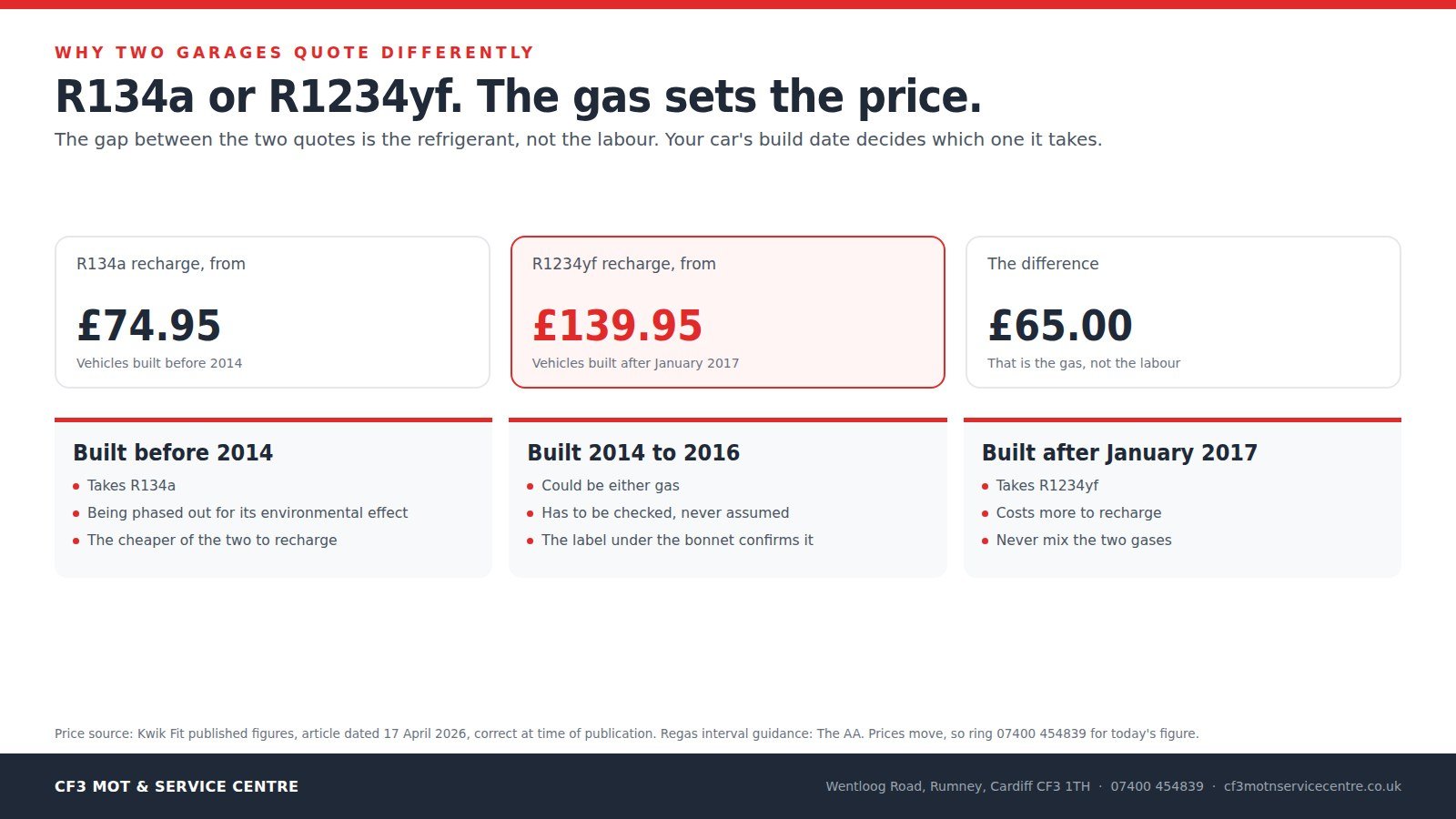
- An R134a recharge starts from £74.95 and an R1234yf recharge starts from £139.95, on Kwik Fit published pricing in an article dated 17 April 2026, stated as correct at time of publication.
- The £65 difference between those two figures is the gas, not the labour, because the work on your car is the same.
- R134a is used in vehicles manufactured before 2014. R1234yf is used in vehicles manufactured after January 2017. Cars built between those dates can be either, so your gas type is checked rather than assumed.
- The two gases must never be mixed. Mixing them can cause dangerous chemical reactions, according to AA guidance on air conditioning regassing.
- Most manufacturers recommend a regas every 2 years and a full air conditioning service every 30,000 miles or 2 years, per the same AA guidance.
What is an air conditioning regas
An air conditioning regas is a four stage process run with a dedicated machine: your refrigerant is recovered and weighed, the system is vacuum tested for leaks, fresh oil is added, and the charge is replaced to the manufacturer weight.
The weighing stage is the part that matters to you. The machine records how much gas came out of your car and compares it with the weight your manufacturer specifies.
Refrigerant also carries the compressor lubricant around the system, so fresh oil goes in with the new charge, which is why a regas is not the same as topping up a tyre.
Cardiff air conditioning work is set out in full on the CF3 car air conditioning page. The focus here is the gas, because the gas moves the figure you are quoted.
Why do two garages quote very different prices for a regas
Two garages quote very different prices because they are pricing two different gases. The labour, the machine time and the vacuum test are the same on both systems, but the refrigerant inside an R1234yf car costs more per vehicle than R134a.
A cheaper quote is often a quote for the wrong gas. You ring three garages, read out your registration, and one answers with a standard R134a price without establishing what your car takes. That quote changes once your car arrives, and you hold the difference.
Stock is the second reason for a spread in prices. A garage that only holds R134a cannot do the job on an R1234yf vehicle at all, and a garage that holds both funds two sets of gas, two sets of hoses and in many cases two machines.
Ask which refrigerant your price covers and the spread stops being a mystery.
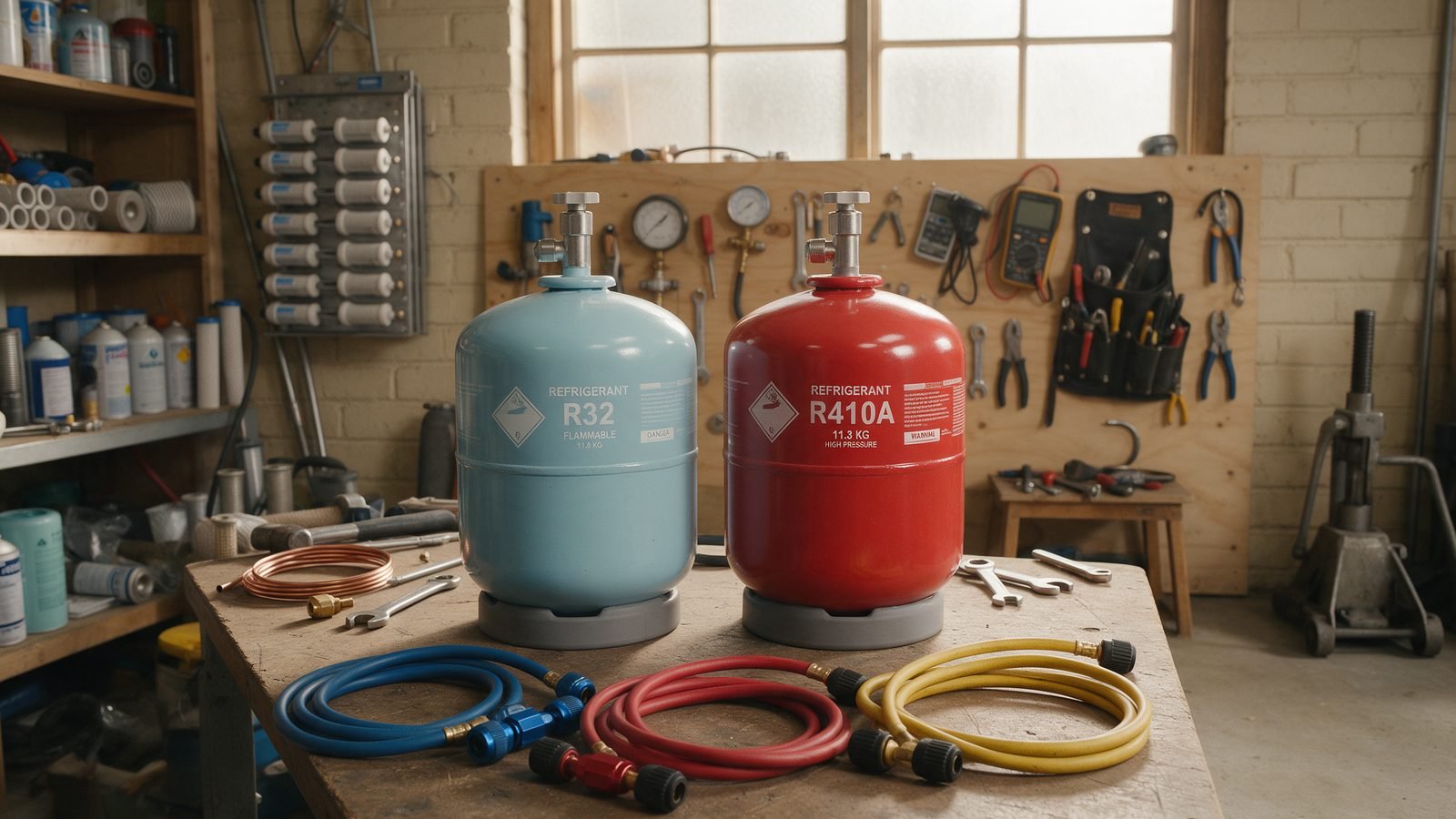
Which gas does your car use, R134a or R1234yf
The gas your car uses is set by when your vehicle was built, not by the make or the model. R134a is used in vehicles manufactured before 2014. R1234yf is used in vehicles manufactured after January 2017.
Cars built between 2014 and January 2017 fall in a changeover window and can take either gas. Manufacturers moved at different times, so two cars of the same model and year can differ. If your car sits in that window, the gas type is checked rather than assumed.
Three checks settle the question for your car:
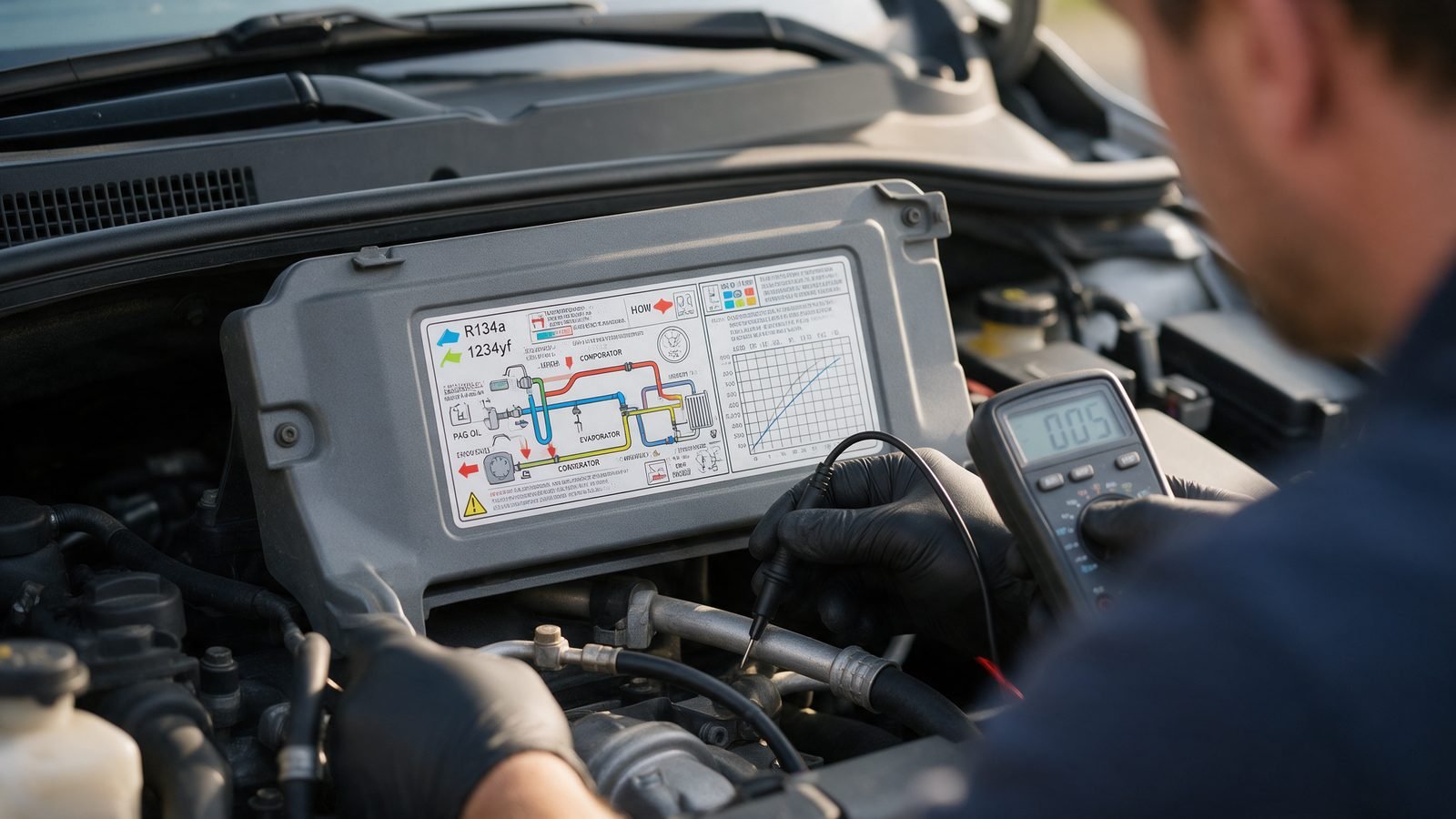
- The under bonnet label. Almost every vehicle carries an air conditioning information label on a slam panel, a strut top or under the bonnet, stating the refrigerant type and the charge weight in grams.
- The service port fittings. R134a and R1234yf use different port couplings, so the hoses from one machine do not fit the other, and a technician can confirm your gas type by the fitting.
- The build date, not the registration year. Your car can be first registered in 2017 and manufactured in 2016, and the manufacture date is the one that counts.
The two gases must never be mixed, and AA guidance states that mixing them can cause dangerous chemical reactions. Your system is designed, sealed and lubricated around one refrigerant, so putting the other in is not a cost saving.
R134a has been phased out because of its environmental effects, which is why the replacement gas carries the higher price and why that gap is unlikely to close. The gas your car takes therefore sets the figure you hear on the phone.
Want to know which gas your car takes?
Ring 07400 454839 with your registration and the make and Ali can confirm your gas type before you book in. The right gas from the start saves you a changed price on the day.
How much does an air conditioning regas cost
An air conditioning regas starts from £74.95 for R134a and from £139.95 for R1234yf, on Kwik Fit published pricing in an article dated 17 April 2026, with the prices stated as correct at time of publication. The gap between the two figures is roughly £65.
That £65 is the gas, not the work, which is why a 2019 car and a 2011 car can both be quoted honestly and carry very different numbers.
Published figures are a starting point rather than a regas quote for your own car. Charge weights differ between vehicles, and a system that needs a leak test or a repair before it will hold gas is no longer a straight regas.
Prices move so ring for today’s figure on 07400 454839 and give the registration.
How often should air conditioning be regassed
Air conditioning should be regassed every 2 years, which is what most manufacturers recommend according to AA guidance, with a full air conditioning service every 30,000 miles or 2 years. Your system loses refrigerant naturally through seals and hose walls.
Natural loss is slow. A sealed system in good order gives up a fraction of its charge each year, and the cooling drops off so gradually that you are unlikely to notice until a hot week in June. The two year interval exists because of that drift, not because refrigerant expires, and a car with no regas in eight years is probably on a part charge that makes your compressor work harder for less cooling.
A used car with no service history is its own case. You have no record of what the last owner did, and the charge weight recorded during a recovery answers that in one reading. Interval advice only helps when you know your car’s history, which is why the symptoms below matter more than the calendar.
What are the signs the air conditioning needs regassing
The signs your air conditioning needs regassing are warm air from the vents, no memory of the last recharge, or a used car bought with no record of one, which are the three indicators in AA guidance.
Warm air is the sign you notice first, and it arrives gradually in most cases. Cooling that used to be sharp becomes mild, then nothing. A system that failed over one weekend rather than two summers points at a leak or a component rather than slow loss.
Two further signs are worth watching. Your windscreen takes longer to clear on a cold damp morning, because the air conditioning is also your demister. Your compressor runs continuously without the engine note changing, because a low charge keeps the pressure switch calling for more cooling.
None of those signs confirms low gas on its own. All of them justify a test, and the test is where your money stops being guesswork.
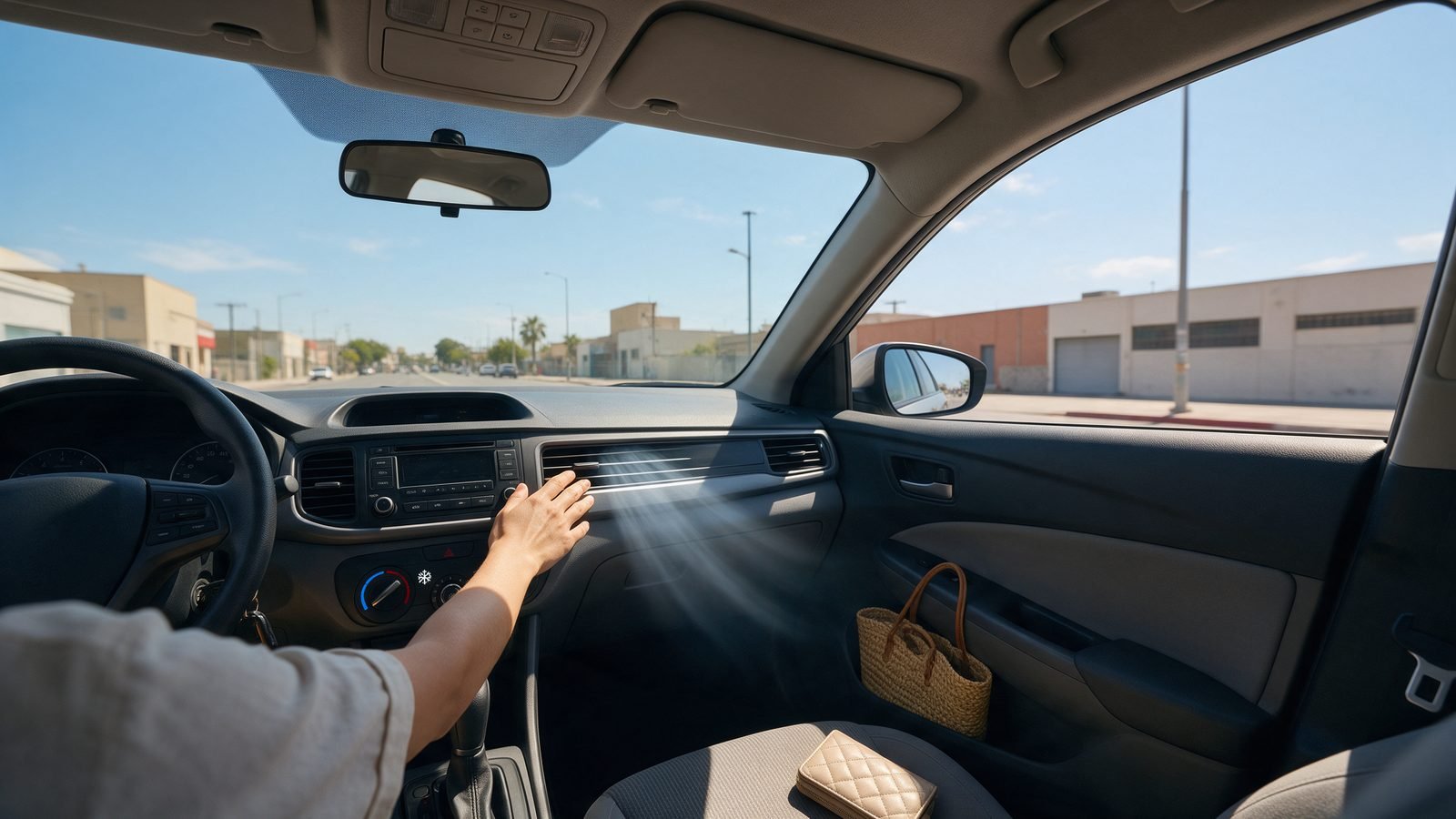
Will a regas fix air conditioning that blows warm, and what does a regas not fix
A regas fixes air conditioning that blows warm only when low refrigerant is the actual fault, which is why your system is tested before it is filled. A regas is a refill, not a repair. A system that is empty twelve months after a recharge has a leak, and refilling it without finding the leak means paying twice.
Slow natural loss over several years is a regas job. Total loss inside a year is a leak job. The recovery weight separates the two for you, because a machine that pulls back almost nothing from a recent recharge has answered the question before any new gas goes in.
Finding your leak takes one of two methods. An ultraviolet dye goes into the system, the air conditioning is run, and the joints, hoses, condenser and compressor are inspected under a UV lamp for a trace of escaped refrigerant. An electronic leak detector, or sniffer, is passed along the same route and alarms on refrigerant around a fitting. Dye is better on slow weeping seals that need time to show, and a sniffer is faster on a larger leak and reaches places a lamp cannot see.
A regas does not fix any of the following faults on your car:
- A failed compressor. A seized clutch, a worn internal pump or an open electrical circuit stops gas circulating however much goes in.
- A blocked or damaged condenser. It sits at the front of your car, takes stone damage and road salt, and a blocked core cannot shed heat.
- A faulty pressure switch or temperature sensor. A system that cannot read its own pressure will not engage the compressor, so your gas sits doing nothing.
- An electrical fault. A blown fuse, a failed relay, a broken wire to the compressor clutch or a fault code in the climate module all present as warm air.
- A blend flap or actuator fault. A flap stuck on the heater side mixes hot air into a cold system.
Diagnosis before a refill is the point, because every fault on that list leaves you paying for gas that cannot cure it. Pressure readings on both sides, a scan of the climate module and a check of the compressor clutch separate a gas problem from a parts problem. Where a fault code is involved, engine diagnostics comes first.
Book a leak test rather than a blind refill
A system that lost its charge inside a year needs the leak found first, not a blind regas. Ring 07400 454839 and ask for your system to be tested at the workshop before it is filled.
Why should the air conditioning be run in winter
The air conditioning should be run in winter because the compressor seals need the lubricant that circulates with the refrigerant, and a system left off for months runs dry at the seals. Dry seals shrink, harden and leak, which turns your unused system into a leaking one.
Running the air conditioning for ten minutes a week through the cold months keeps oil moving around the circuit. The setting does not have to be uncomfortable, because the compressor runs whenever the air conditioning button is on, even with the dial turned up.
The stronger winter argument is visibility. Air conditioning is a dehumidifier as well as a cooler, so it doubles as the fastest demister on your car and clears a misted windscreen in a fraction of the time heat alone takes.
October is therefore a better month to fix your air conditioning than June. A failed system is a winter visibility problem before it is a summer comfort problem, and the workshop diary is shorter now than in the first warm week of the year. Winter running keeps your seals wet and the evaporator damp, which is where the other common complaint starts.

Why does the air conditioning smell musty
A musty smell from your air conditioning comes from bacteria and mould growing on the damp evaporator, or from a saturated cabin filter, and neither has anything to do with the refrigerant charge. A regas will not cure a smell.
The evaporator sits behind your dashboard and runs cold and wet by design, because stripping moisture out of the air is part of how cooling works. Condensation drains through a pipe under your car, and organic matter builds up on the fins and grows in the damp.
Your cabin filter, also called the pollen filter, sits in the same air path and traps leaves, dust and moisture. A filter left in place for years holds enough damp debris to smell on its own, and a blocked one cuts airflow at your vents, which reads like weak air conditioning.
Two pieces of work deal with a smell. A new cabin filter comes first, and an antibacterial treatment through the evaporator and ductwork deals with what is growing on the fins. Cabin filter replacement sits within a normal car service on most vehicles, so the two combine on one visit. A smell, a weak vent and a flat charge are three different jobs, and the order decides whether you pay once or twice.
Air conditioning work at CF3 MOT and Service Centre in Rumney
CF3 MOT & Service Centre is a DVSA approved MOT test centre and all makes garage at Unit 4C Wentloog Buildings, Wentloog Road, Rumney, and the workshop handles both R134a and R1234yf systems. Ali is the owner and lead technician at the Rumney workshop on Wentloog Road, so you deal with one named owner who quotes and signs off every job.
The order of work on your car is the same on every air conditioning job at the workshop. Your gas type is established from the vehicle label and the port fittings. The test comes before the gas, so the existing charge is recovered and weighed, which shows whether your loss is slow drift or a leak. A regas goes ahead where low charge is the fault, and where the readings point elsewhere, the garage tells you what it found before it does the work, with a price for the repair.
A regas quote names the gas, so the phone figure is for your car rather than a headline price for a different refrigerant.
The workshop sits about ten minutes from Cardiff city centre and five minutes off the A48, and serves Rumney, St Mellons, Llanrumney, Pentwyn, Splott and Roath. Collection and delivery is available if a drop off at Wentloog Road does not suit you, subject to availability. Your regas is booked as its own job rather than added to a service, because the machine needs dedicated time in the bay. Where an MOT is due at the same time, our guide to MOT and service prices in Cardiff sets out how the two bookings fit together.
Air conditioning regas questions
Is the air conditioning checked during an MOT
The air conditioning is not an MOT test item, so a system blowing warm air has no effect on your result. The MOT does cover your windscreen, wipers and washers, for the same visibility reason. A failed system still needs booking as separate work alongside your MOT. Evening and Saturday appointments are listed on the evening and weekend appointments page, subject to availability.
Is an air conditioning regas included in a standard car service
An air conditioning regas is not included in most car services. AA guidance states that many car services do not include the air conditioning system, which is why your regas usually needs booking separately. A service covers oil, filters and a safety inspection on a set menu, while a regas needs a recovery machine, the correct gas and dedicated bay time.
Can a DIY top up kit be used instead of a garage regas
A DIY top up kit adds gas without recovering or weighing what is already in your system, so you have no way of knowing your final charge. An overfilled system cools badly and loads your compressor. Kits are sold for one refrigerant, and the two gases must never be mixed. A kit does nothing about the leak that emptied your system.
What happens to the old refrigerant during a regas
The old refrigerant is drawn out of your system by the service machine, weighed, filtered and stored rather than released into the air. Recovery is why the job needs a machine and a trained technician instead of a can. The recovered weight is also the reading that matters to you, because the gap between it and the manufacturer charge weight shows how much had been lost.
Does running the air conditioning increase fuel use
The air conditioning increases fuel use while it is switched on, because the compressor is driven by the engine and takes power to turn. A correctly charged system costs you less to run than a part charged one, because a low charge keeps the compressor cycling for longer. A blocked cabin filter adds to that by restricting airflow.
What is a full air conditioning service and how is it different from a regas
A full air conditioning service goes beyond the gas. AA guidance puts the interval at every 30,000 miles or 2 years. The work covers the refrigerant charge plus the system pressures, the compressor operation, the condition of pipes and seals, your cabin filter and an antibacterial clean. A regas on its own addresses the charge and the leak test.
Getting a straight answer on your air conditioning
Your air conditioning question has a factual answer rather than a judgement call. R134a recharges start from £74.95 and R1234yf recharges start from £139.95 on Kwik Fit published pricing dated 17 April 2026, correct at time of publication, and knowing which gas your car takes turns a spread of quotes into one price.
Book your car into the garage in Rumney on 07400 454839 and ask for your gas type to be confirmed before any new gas goes in. The Wentloog Road workshop weighs your old charge first, so you see what came out of your car before you pay for what goes back.
Find out which gas your car takes
Ring CF3 MOT and Service Centre in Rumney on 07400 454839, or book through the widget above. The label under the bonnet is checked first, so you are quoted for the gas your car actually uses.

