
Book Online
07400454839
-
By: Ali Hindal
- 0 Comments
Is a wet belt the same as a cambelt? Yes and no. A wet belt is a type of cambelt: it does the same job of keeping the crankshaft and camshafts in time, but it runs inside the engine, bathed in engine oil, instead of dry behind a plastic cover. That one difference changes how the belt wears, what makes it fail early, and how and when it needs replacing, which is why a wet belt replacement is a different job from a standard cambelt change.
If your car has a wet belt and you treat it like an ordinary cambelt, you can lose the engine with no warning. That is the short version, and it is why this is worth ten minutes of your time. A wet belt and a cambelt do the same job, keeping your engine timed correctly, but they live in different places, fail in different ways, and need different care.
Plenty of drivers around Cardiff are sitting on a wet belt without knowing it. If you own a Ford EcoBoost or a Peugeot, Citroën, DS or Vauxhall PureTech, this is you. Here is what the difference actually means for your car and your wallet.
Wet belt against cambelt, at a glance
- A wet belt is a cambelt. It just runs inside the engine in the oil rather than outside behind a plastic cover.
- A dry cambelt can be inspected by taking the cover off. A wet belt cannot be seen without stripping the front of the engine.
- A dry belt tends to fail by snapping. A wet belt fails by delaminating and shedding rubber into the oil.
- The debris blocks the oil pump pickup, oil pressure collapses, and the engine destroys itself from the inside.
- Ford EcoBoost and Stellantis 1.2 PureTech engines are the two most common wet belt engines on Cardiff roads.
- Lifetime is no longer the guidance on these engines. The revised figures are years first, mileage second.
What is a cambelt?
A cambelt, or timing belt, is a toothed rubber belt that keeps the top of your engine turning in time with the bottom. On a conventional engine it runs dry, on the outside of the block, behind a cover. You change it at the interval in your handbook, usually a set mileage or number of years, whichever comes first, and a snapped one can bend valves and wreck the engine.
That much most drivers know. The cambelt has been the standard timing part for decades, and a planned change is a routine, predictable job.
What is a wet belt, and how is it different?
A wet belt is a timing belt that runs inside the engine, submerged in oil. Carmakers moved to the design to save fuel, because a belt running in oil has less friction than one running dry, which trims emissions and consumption by a small margin. The first wet belts appeared around 2007, and they are now common on small modern petrol engines.
The catch is how they fail. A dry cambelt mostly fails by snapping. A wet belt fails by falling apart slowly. As it ages in the oil it sheds tiny rubber crumbs, and those crumbs get carried through the engine and collect on the oil pickup strainer, the filter that feeds oil to everything that moves. Block that strainer and the engine starves of oil and can seize. The trade is full of accounts of this happening with no warning light until the damage is done.
Wet belt vs cambelt vs timing chain, in plain terms
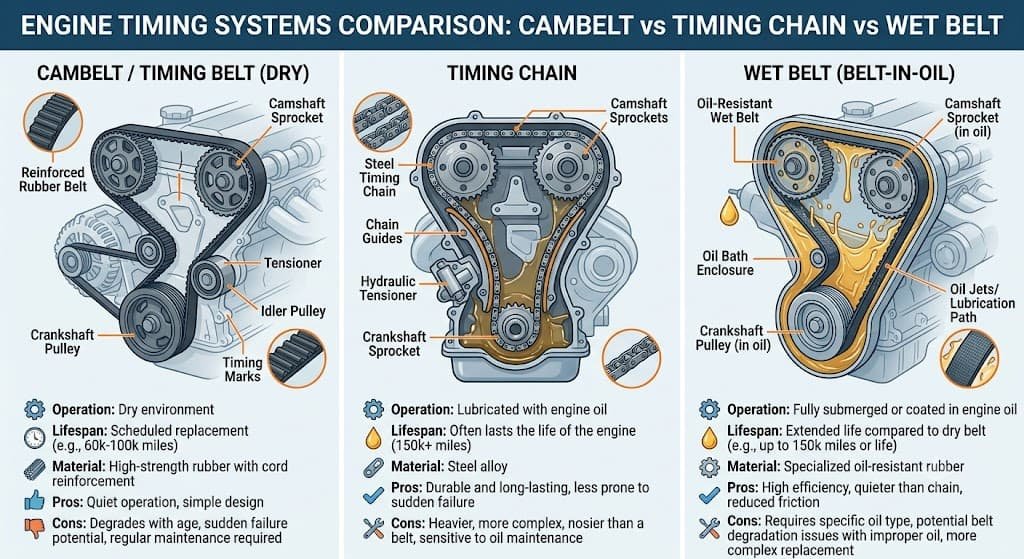
There is a third option that adds to the confusion: the timing chain. So here are all three side by side.
- Cambelt: dry rubber belt, outside the engine, changed on a fixed schedule.
- Wet belt: rubber belt, inside the engine in oil, changed on schedule but ages faster on short trips and bad oil.
- Timing chain: metal chain, inside the engine in oil, designed to last much longer though not forever, and dependent on clean oil.
If you do not know which your car has, you are not alone, and it is the single most important thing to establish. The registration tells us in a minute.
Not sure which belt your car has?
Give us your registration and we will tell you in a minute whether you have a wet belt, a cambelt or a chain , and whether it is due for attention. No commitment, no pressure.
Which is worse to ignore?
Both belts are serious, but a wet belt is more deceptive. A cambelt usually gives you an interval to plan around and sometimes a noise before it goes. A wet belt can be quietly degrading while the car drives perfectly, then take the engine out through oil starvation rather than a clean break. That hidden nature is exactly why wet belt owners need to be more proactive, not less.
Which cars have a wet belt?
The wet belt is fitted across a range of popular engines, so the odds are higher than most people think. Cars that commonly use one include:
- Ford 1.0, 1.5 and 1.6 EcoBoost petrol engines, found in the Fiesta, Focus, Puma, EcoSport and others
- The 1.2 PureTech petrol shared across Peugeot, Citroën, DS and Vauxhall
- Several Ford EcoBlue diesel engines
These are everyday cars, the kind parked on every street in Rumney and Llanrumney. If you are not sure what is under your bonnet, the registration tells us, and we are happy to check it for you.
Why short Cardiff journeys make it worse
Here is the part that hits local drivers hardest. Wet belts degrade faster on short, cold trips, and a lot of Cardiff driving is exactly that. School runs around St Mellons, a five-minute hop to the shops, the daily crawl into town and back. On journeys that short, the oil never reaches full temperature, so moisture and unburnt fuel mix into it and accelerate the belt’s wear. A car that does mostly motorway miles is gentler on its wet belt than a city runaround with the same mileage on the clock.
Two simple habits protect the belt between changes. Change the oil on time, every time, and only ever use the exact oil specification the manufacturer lists, because the wrong oil eats the belt material faster. Both are covered when we carry out a full car service, which is why skipping services on these engines is a false economy.
Do low-mileage cars get a pass?
No, and assuming they do is how good-looking, low-mileage cars end up with destroyed engines. The belt ages with time and with the kind of driving it does, not just with distance. A six-year-old PureTech that has covered modest miles entirely on short local trips can be worse off than a higher-mileage car driven mainly on the motorway. Go by age and use, not the odometer alone.
Warning signs to act on
The belt is hidden, so you watch for the secondary symptoms rather than the belt itself. Get it checked if you notice:
- A rattle, whine or grinding noise, loudest on a cold start
- Rough idling or a misfire
- An oil leak around the timing cover
- Any flicker of the oil pressure or engine warning light
Treat the oil light as a stop signal. If it flickers, even briefly, pull over safely and call us, because debris may already be choking the oil supply, and every further mile risks the engine.
What to do next
If you drive an EcoBoost or PureTech, do not wait for the original handbook interval to come round. Several manufacturers have shortened their guidance as the real-world failures stacked up, so the safe move is to have the belt inspected once the car is around six years old or nearing its mileage, and earlier if it has lived on short trips. A planned wet belt replacement is a known, manageable cost. An engine destroyed by a clogged oil pickup is a far bigger one.
CF3 MOT & Service Centre is on Wentloog Road in Rumney, and we look after EcoBoost and PureTech owners across Rumney, Llanrumney, St Mellons and the wider Cardiff area. Send us your registration and we will tell you which timing system your car has, whether it is due, and what a replacement would cost.
Wet belt questions.
How do I know if my car has a wet belt or a cambelt?
The quickest way is to give us your registration and let us check. As a rule of thumb, Ford EcoBoost and 1.2 PureTech engines from Peugeot, Citroën, DS and Vauxhall use wet belts, while many other engines use a conventional dry cambelt or a timing chain.
Is a wet belt more expensive to replace than a cambelt?
The cost is similar in principle, though it varies by engine because access differs and the oil is renewed as part of the job. The bigger financial point is that replacing either belt on time costs a fraction of the engine repair you face if it fails.
Can I just leave the wet belt until the manufacturer’s mileage?
It is risky. Real-world failures often happen earlier than the original interval, especially on cars used for short journeys, which is why many garages now recommend inspecting and replacing sooner.
Does the type of oil really matter that much?
Yes. The wrong oil specification degrades the belt material faster, so using the exact oil your manufacturer lists, and changing it on schedule, is one of the main things that decides how long the belt lasts.
Can a wet belt be converted to a chain?
For some engines there are conversion kits, but it is a bigger specialist job that does not suit every car. Ask us about your specific engine and we will tell you honestly whether it is worth considering.
I drive an EcoBoost mostly around Cardiff. Should I be worried?
You should be proactive rather than worried. Short city journeys are harder on wet belts, so keep your services and oil changes up to date and have the belt inspected as the car ages. Caught early, it is a routine job.
Book a wet belt inspection.
If you drive an EcoBoost or PureTech, a quick check now is the cheapest insurance you will buy all year. Call CF3 in Rumney or send your registration and we will take it from there.
A quick check now is the cheapest insurance you will buy all year.
If you drive an EcoBoost or PureTech, send us your registration. We will tell you which timing system your car has, whether it is due, and what a replacement would cost , with no pressure either way.
