
Peugeot 2008 PureTech Misfire: What a Compression Test Showed
  • Home
  • Peugeot 2008 PureTech Misfire: What a Compression Test Showed

Peugeot 2008 PureTech Misfire: What a Compression Test Showed

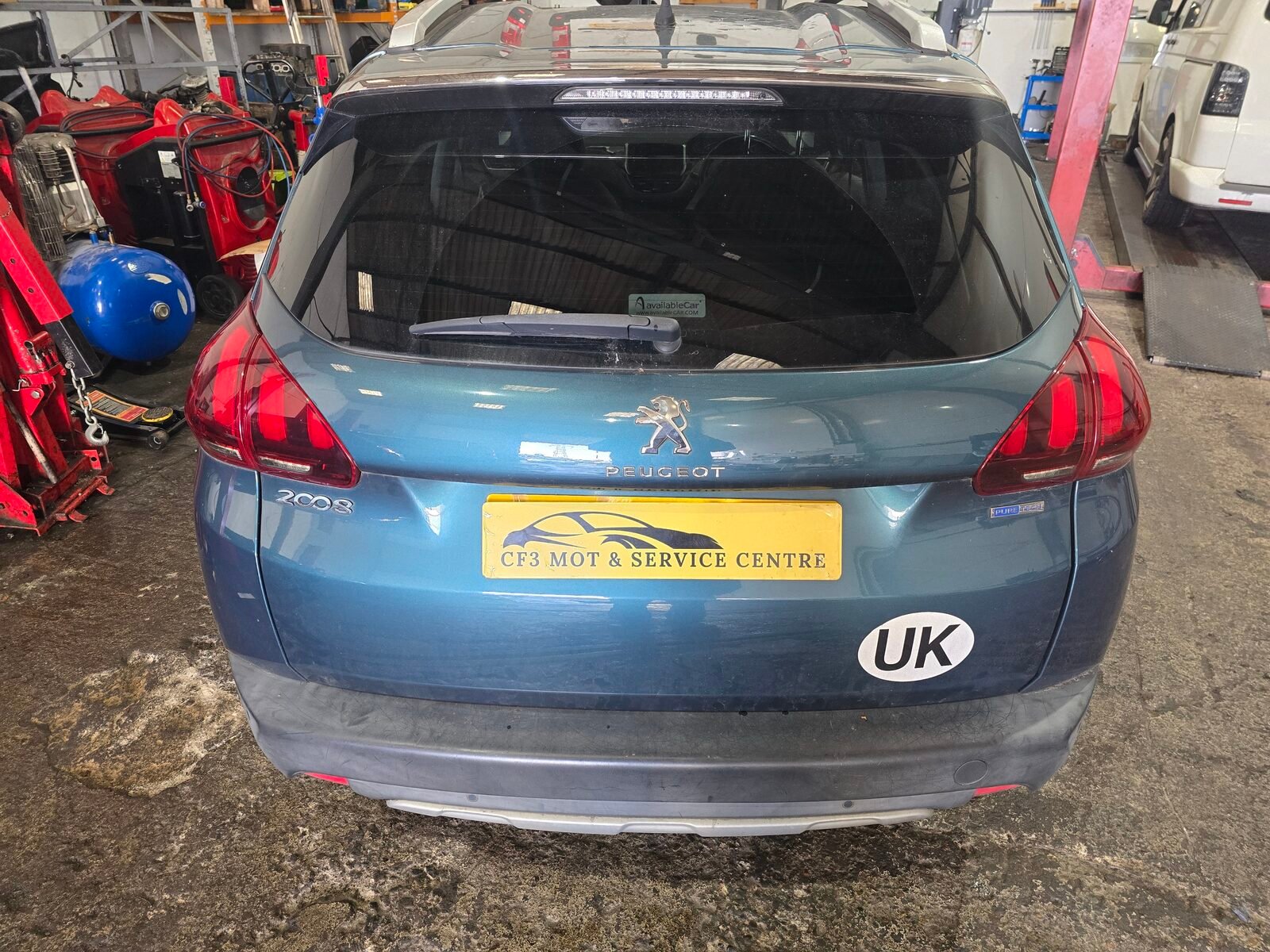
Rear of a teal Peugeot 2008 carrying a PureTech badge, parked inside the CF3 MOT and Service Centre workshop in Rumney, Cardiff, booked in with a misfire on cylinder three.

A Peugeot 2008 with a PureTech petrol engine came into our Rumney workshop misfiring on cylinder three. A misfire on one cylinder has three families of cause: it is not getting a spark, it is not getting fuel, or it cannot hold pressure. The first two are cheap to check and cheap to fix. The third is the one nobody wants. Our technician pulled the coils and the plugs and put a compression tester into each cylinder in turn, because that is the test that separates the three. One cylinder came up just above 60 psi. The next one did not move off zero. At that point the job stopped being a misfire and became a compression failure, and the conversation with the owner changed completely.

The two gauge readings on this page are photographs taken on the ramp, not figures quoted from memory.

Misfiring, running rough, or showing an engine light on a PureTech? Book it in for engine diagnostics at our Rumney workshop, where the test comes before the quote and the reading goes on the job sheet alongside the price.

  • The car was a Peugeot 2008 with a PureTech petrol engine, booked in for a misfire on cylinder three.
  • A compression test is how a misfire on one cylinder is separated from a mechanical failure, and it is a quick test once the coils and plugs are out.
  • One cylinder read just above 60 psi on the gauge. The next read zero.
  • A healthy petrol cylinder reads well above 120 psi, and the cylinders on one engine should be close to each other.
  • Zero compression means the cylinder is not sealing at all, so no amount of spark or fuel will make it fire.
  • Diagnosing it properly matters more than fixing it quickly, because the cost of the repair decides whether the car is worth keeping.
  • PureTech engines use a timing belt that runs in oil, which is why the oil and belt history on these engines is always worth asking about.
  • Testing before quoting is the point. A coil, a plug and an injector on the wrong cylinder is money spent for nothing.

What the car came in for, and why a misfire gets tested before it gets parts

The Peugeot 2008 waiting its turn on the workshop floor at Rumney, booked in on a fault code naming cylinder three rather than on a list of symptoms.

The booking was a misfire on cylinder three. That is the most common way this kind of job arrives: the car is shaking at idle, the engine light is on or flashing, and the fault code names a cylinder. The code is useful because it tells you where to look. It does not tell you what is wrong.

A cylinder misfires because it is missing spark, missing fuel, or missing compression. Guessing between those three is how people end up buying a coil pack, following it with a plug, following that with an injector, and still having the same misfire. The order of work is to rule out the cheap causes first, test the expensive one second, and price the repair last.

A fault code naming cylinder three tells you which cylinder to test. It does not tell you what the cylinder has done.

What the gauge showed once the plugs were out.

Coils and plugs came out first

The ignition coils were removed and laid on the slam panel, and the spark plugs came out of every cylinder. That is what a compression test needs: an open cylinder and a free turning engine. It also gives you a look at the plugs themselves, which carry their own evidence of how each cylinder has been running.
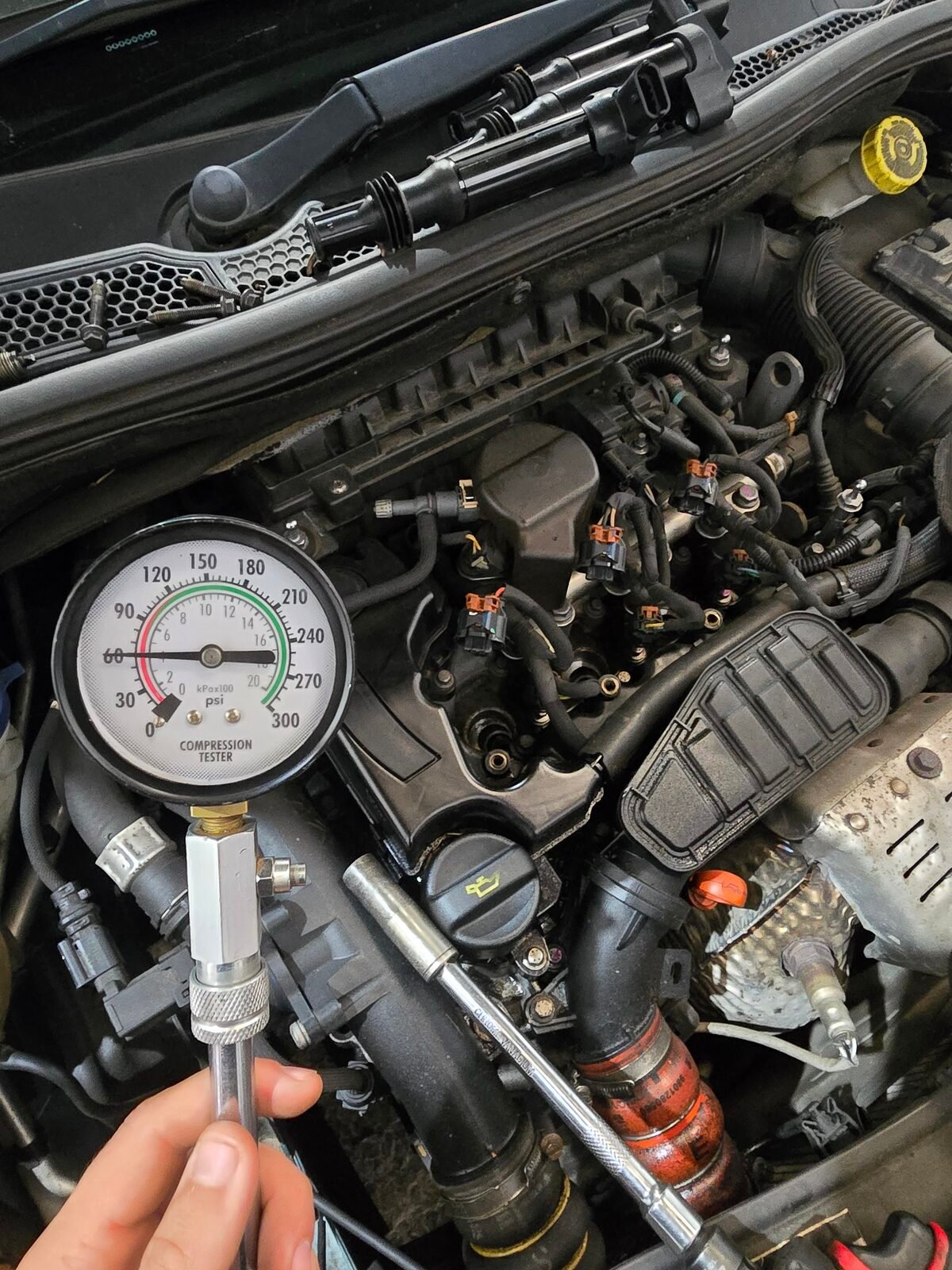
Compression tester screwed into a spark plug hole on a PureTech petrol engine, the gauge needle sitting just above 60 psi, with the ignition coils and plugs removed and laid on the slam panel.

One cylinder read just above 60 psi

With the tester screwed into the plug hole and the engine turned over, the needle climbed and stopped a little above 60 psi. A petrol cylinder in good order reads well above 120. A reading at 60 is not a borderline result that needs a second opinion. It is a cylinder that has lost a large part of its ability to seal.

The next cylinder read zero

The tester moved across, the engine turned over again, and the needle did not leave the stop. Zero. No pressure built at all. A cylinder reading zero is not sealing against the rings, the valves, the head gasket or the piston itself, and no spark or fuel will make it fire.
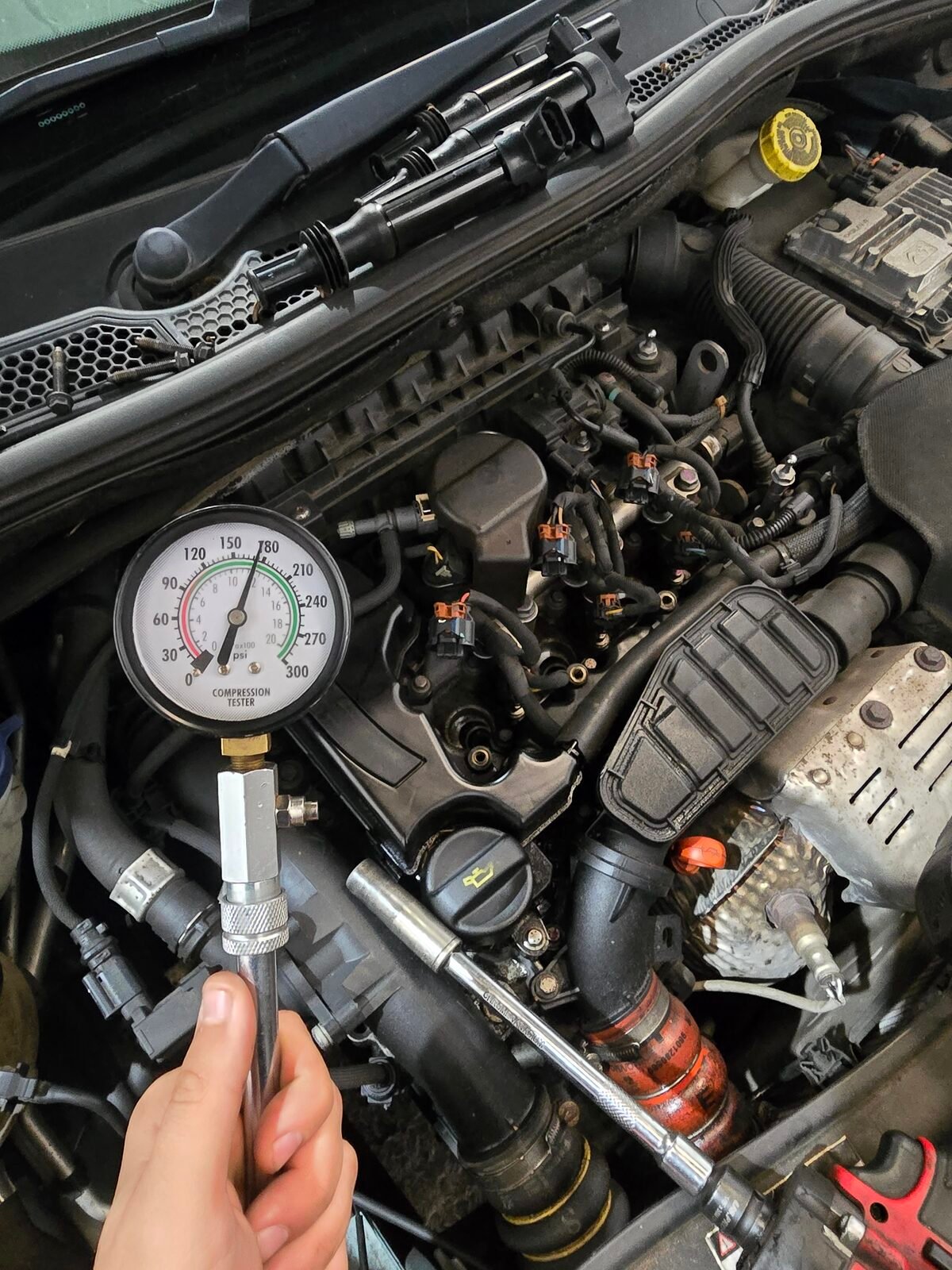
The same compression tester moved to the next cylinder of the PureTech engine, the gauge needle resting on zero with no pressure building as the engine turns over.

// Reading the gauge

What those two numbers actually mean

A compression figure on its own means very little to an owner standing in reception. What makes it readable is the comparison: what a healthy cylinder does, what this one did, and how far apart the cylinders on the same engine are.

A healthy petrol cylinder reads well above 120 psi.

What it means: That is the benchmark the two readings on this engine are being measured against, and both fell a long way short of it.

The cylinders on one engine should read close to each other.

What it means: Compression testing is a comparison test as much as an absolute one. One cylinder at 60 and its neighbour at zero is a bigger finding than either number alone.

About 60 psi is a cylinder that has lost most of its seal.

What it means: It will still fire weakly and it will still make the engine shake, which is why the car drove in rather than being recovered in.

Zero psi is a cylinder that is not sealing at all.

What it means: Nothing is being compressed, so nothing will ignite. Replacing a coil, a plug or an injector on that cylinder changes nothing.

Two readings, taken four minutes apart, turned a misfire diagnosis into an engine condition report.

Want to know what your engine is actually doing before you spend on parts?Call 07400454839

Why the test came before the quote.

The temptation on a named cylinder misfire is to fit the cheap parts first and see what happens. A coil pack is not expensive. Neither is a plug. On plenty of cars that approach works, and it works because the cause really was ignition. On this car it would have cost the owner money and told them nothing.

The reason to test first is that the result changes the decision, not just the invoice. A misfire caused by a coil is a repair. A cylinder reading zero is a question about whether the car is worth repairing at all, and that is the owner's question to answer with real information in front of them. PureTech engines also carry their own history worth knowing about, because the timing belt on these runs in the engine oil rather than dry, which we cover in our guide to the difference between a wet belt and a cambelt.

A compression reading of zero is not a reason to keep driving the car gently. A cylinder that is not sealing is passing combustion gases somewhere they do not belong, and continuing to run the engine can turn one failure into several.

Where compression goes when a cylinder stops sealing.

A cylinder holds pressure using four things. When the pressure goes, it has gone past one of them. Each has a different cost and a different answer.

Piston rings

Past the rings

Worn or broken rings let pressure escape down into the crankcase. This usually shows as low compression rather than none, and it often comes with oil use and blow by at the filler cap.

Best when

Compression is low on more than one cylinder

Valves

Past a valve

A burnt, bent or badly seated valve leaves the cylinder open to the inlet or the exhaust. A bent valve after a belt failure takes compression to nothing very suddenly rather than gradually.

Best when

One cylinder drops away on its own

Head gasket

Past the head gasket

A failed gasket lets pressure out into a coolant passage or into the next cylinder. It brings its own symptoms with it, such as coolant loss, pressure in the expansion tank or a mayonnaise deposit under the filler cap.

Best when

Two neighbouring cylinders are both down

How a compression test is run on a misfiring cylinder.

The test itself is straightforward. The value is in doing it before parts are fitted rather than after, and in writing down every cylinder rather than only the one the fault code named.

The result is read alongside everything else the car is telling you. A flashing engine light, the state of the plugs, whether the engine is using oil and what the coolant looks like all narrow it down further. Our guide to what an engine management light is telling you covers the codes that bring cars in for this test.

Read the fault codes

Confirm which cylinder the engine is reporting, and whether the light is steady or flashing.

Remove the coils and plugs

Every cylinder, because the test is a comparison and one reading on its own says little.

Fit the tester and crank

Turn the engine over on the starter until the needle stops climbing.

Record every cylinder

Write the figures down in order so the spread between cylinders is visible.

Compare against the benchmark

Both the absolute figure and the gap between cylinders carry meaning.

Report before quoting

The owner gets the readings, then the options, then the price.

Compression tester held against the PureTech engine with the needle on zero, the reading that ends a misfire diagnosis and starts a conversation about the engine.

// The result

A misfire booking that ended as an engine condition report

The car came in as a misfire on cylinder three and left with a diagnosis of engine failure on low compression. That is not the outcome anybody wants, and it is still the right outcome, because the alternative was an owner spending money on ignition parts for a cylinder that could not hold pressure in the first place.

Every job that comes through the workshop with a named cylinder in the fault code gets tested the same way. The test takes minutes once the plugs are out. The reading it gives you is the difference between a repair and a decision.

Misfire, rough idle or an engine light that will not clear?Call 07400454839
Next step

Get the cylinder tested before you buy parts for it

We are a DVSA approved test station and workshop on Wentloog Road in Rumney, five minutes from St Mellons and Llanrumney. If your car is misfiring, bring it in and we will test it before we price anything. If you cannot get to us, we can collect it on our collection and delivery service.

Misfire and compression questions.

What does low compression on one cylinder mean?

Low compression on one cylinder means that cylinder cannot hold the pressure it needs to burn fuel properly. The pressure is escaping past the piston rings, past a valve, past the head gasket, or through the piston itself. The cylinder will misfire until the seal is restored.

What is a normal compression reading on a petrol engine?

A petrol cylinder in good order reads well above 120 psi, and the cylinders on the same engine should read close to one another. The gap between cylinders matters as much as the absolute figure, because a large spread points at one cylinder having a specific fault.

Can a misfire be caused by something cheap?

Yes, and often it is. Coil packs, spark plugs and injectors all cause single cylinder misfires and all cost far less than engine work. That is exactly why the compression test comes first, so the cheap causes are ruled in or out on evidence rather than on hope.

Is it safe to keep driving a car that is misfiring?

Driving on a misfire risks further damage. Unburnt fuel passes into the exhaust and can destroy the catalytic converter, and a cylinder that is not sealing is sending pressure where it does not belong. A flashing engine light means stop driving and get it looked at.

Why does a PureTech engine need its belt history checked?

The timing belt on a PureTech runs inside the engine in oil rather than dry outside it. That makes its condition dependent on oil quality and service history in a way a conventional belt is not, so the servicing record carries more weight on these engines than on most.

Do you test every cylinder or only the one in the fault code?

Every cylinder. A compression test is a comparison, so a single reading in isolation is worth much less than the full set. Testing all of them also catches a second cylinder that has started to drop but is not yet misfiring.

Where are you, and can you take the car this week?

We are on Wentloog Road in Rumney, Cardiff, CF3 1TH, a few minutes from St Mellons and Llanrumney. Call 07400 454839, and if daytime is difficult we also run evening and weekend appointments.