Book Online
07400454839
-
By: Ali Hindal
- 0 Comments
A brake noise names its own cause more often than drivers expect: a squeal comes from the pad surface or a wear indicator, a grind comes from metal on metal, and a soft pedal comes from the hydraulic side rather than the friction side. Your car is making a sound you have not heard before, and you cannot tell whether it needs a garage today or at the next service. This page maps every squeal, grind, judder and pedal change onto the part that produces it.
What your brakes are telling you, at a glance
- A light squeal on the first stops of a cold morning is rust leaving the discs.
- A squeal still there once the brakes are hot is a wear indicator or a glazed pad.
- Metallic grinding means the friction material has gone and the backing plate is on the disc.
- A rumble that rises with road speed, foot off the brake, is a wheel bearing.
- A judder through the pedal comes from uneven disc thickness.
- A spongy, long or sinking pedal is hydraulic: fluid draws in water, and water boils.
- A pull to one side and a burning smell both mean a caliper is binding.
- A brake pad worn below 1.5mm is a major defect under the DVSA MOT inspection manual.
Not sure whether that noise can wait until the weekend?
Ring the workshop and say what you hear and when you hear it. Whether a squeal is there only from cold, or still there when hot, decides how soon the car comes in.
A squeal from the brakes
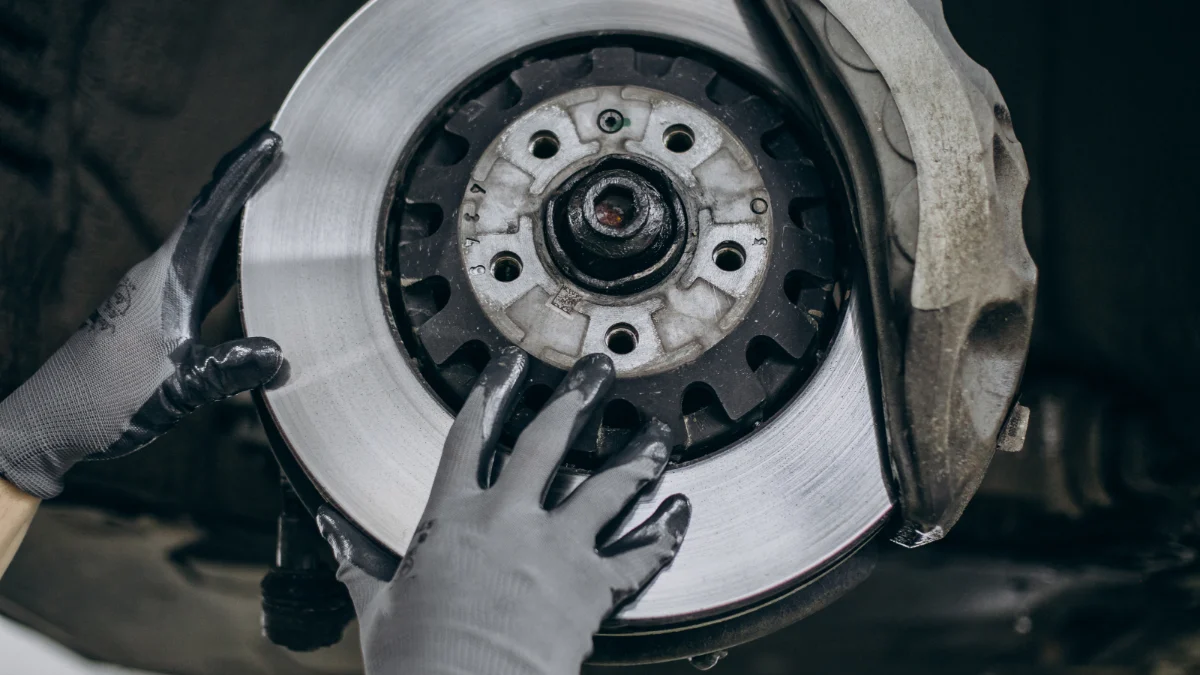
A brake squeal is friction material vibrating against the disc. What matters is whether it clears or stays.
A light squeal from cold that goes after a few stops
A light squeal on the first few stops of the day, fading as the brakes warm, is surface rust being scrubbed off the discs. Cast iron oxidises overnight and the pads clean the swept face within a few applications. The car is safe to drive and nothing needs replacing.
A constant squeal that does not go
A squeal that continues once the brakes are hot, at every stop, is either a wear indicator touching the disc or a glazed pad surface. Both need the wheel off to confirm.
Most pads carry a wear indicator: a steel tab bent off the backing plate, set so that it reaches the disc once the friction material reaches a planned depth. The tab is designed to squeal, as a warning built into the part rather than a fault in it.
Glazing is the other cause. Pad material overheated by a long descent or a dragging caliper goes hard and smooth. A pad still has material left when its indicator first sounds, and that margin shrinks every time you brake. Pads, discs and calipers are all car brake repairs, quoted after the thicknesses are measured.
A metallic grinding, and why discs have a minimum thickness
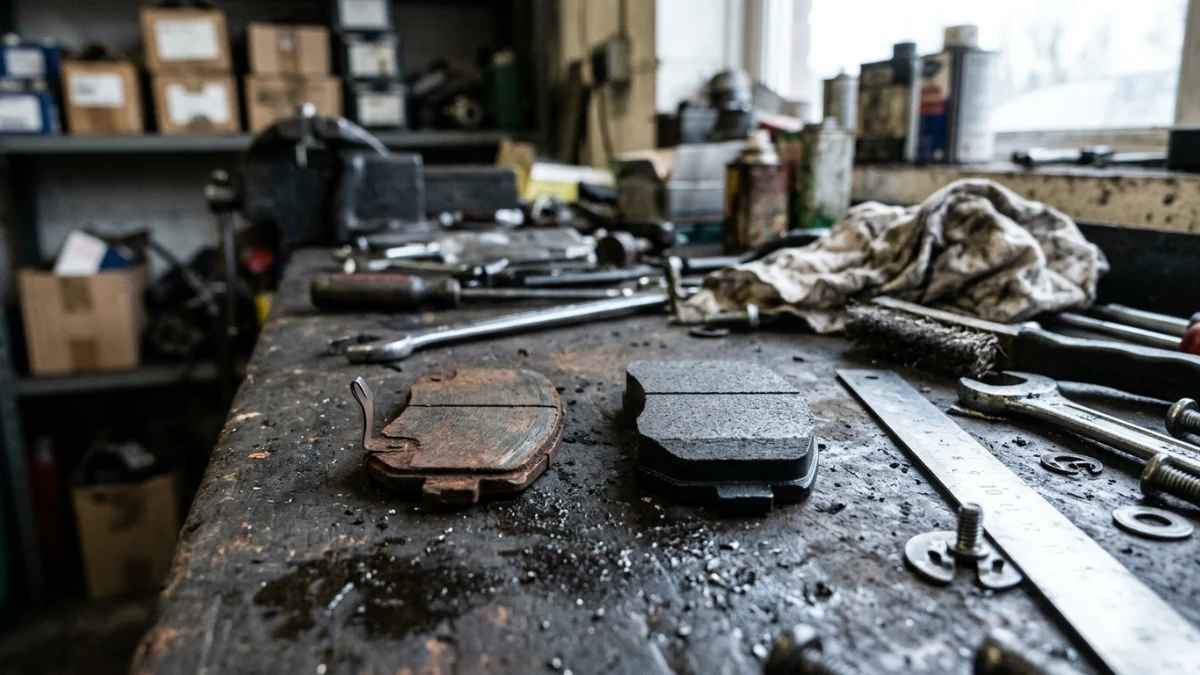
Metallic grinding under the pedal means the friction material has gone and the pad backing plate is running on the disc. That is steel cutting cast iron, and every stop removes disc thickness. Stop driving: braking distance is longer and a cut disc can crack.
Every disc carries a minimum thickness figure cast into its hub, and the disc is scrap once it reaches that figure. A thin disc holds less heat and flexes more, so it cracks and fades sooner. Thickness is measured with a micrometer at several points, because wear is rarely even.
A brake pad worn below 1.5mm is a major defect under the DVSA MOT inspection manual. Pad and disc readings are taken at every tier of interim, full and major service. Test before you quote, and the reading goes beside the price.
A rhythmic grinding or rumble that changes with speed
A rumble that rises and falls with road speed, and carries on with your foot off the brake, points at a wheel bearing rather than a brake. The noise follows wheel speed, not how hard you are stopping.
A bearing with pitted rollers or races growls, and the growl changes as you corner, because cornering shifts load across the car.
A loud bearing is not driveable, because hub play changes how the brake clamps. Hubs and bearings are suspension and steering work.
A judder or pulsing through the pedal under braking
A judder felt through the brake pedal under braking comes from uneven disc thickness. The disc varies slightly around its face, so clamp load rises and falls once per revolution.
Three mechanisms produce that variation. Pad material transfers unevenly onto a hot disc and builds up in patches. A corroded hub face holds a new disc slightly out of square, so it runs with a wobble from the day it goes on.
A mild judder is driveable, and a judder with a long pedal is not. Run out is checked with a dial gauge, and the hub face is cleaned to bare metal before new discs go on.
A pedal that has gone soft or long
The pedal reports on the hydraulic side of the brakes, not the friction side.
A spongy or long pedal
A spongy pedal that travels further than it used to means something compressible is in a system designed to carry only fluid. Air compresses. Brake fluid does not.
Air enters through a repair that was not bled properly, a reservoir run low, or a seal that draws air as it releases. Moisture is the route drivers never see. Brake fluid is glycol based and hygroscopic, so it draws water out of the atmosphere through the reservoir cap, the hoses and the seals. Water lowers the boiling point, and heat from repeated heavy stops boils it into vapour. Vapour compresses, so the pedal goes long and firms up as it cools.
Treat a pedal that has gone long as a car to check immediately. Fluid moisture content is measured at the reservoir, and the fluid is replaced to the manufacturer interval.
A pedal that sinks slowly while you hold it
A pedal that sinks under a steady foot means fluid is getting past something: either a master cylinder seal is letting it bypass internally, or there is an external leak.
An internal bypass leaves no puddle. An external leak shows as a wet film at a union, a damp hose, a weeping piston seal or a stain on a steel pipe. A pipe corroded through after years of winter salt gives way without warning.
Stop driving a car with a sinking pedal, because a system losing pressure fails suddenly. Corroded pipes are replaced rather than patched, and pipe corrosion is one of the reasons cars fail the MOT in Cardiff.
A brake that binds: pulling to one side and a burning smell
A brake that does not release fully drags its pad against the disc. Two symptoms follow: the car pulls to one side under braking, and there is a hot, sharp smell after a run.
A pull means more braking effort on one side than the other, usually a caliper not releasing or a seized slide pin holding a pad off its disc. Slide pins carry the caliper body across the disc so that both pads clamp evenly. Grease dries out, the pins corrode, and the caliper cannot centre itself. A hose perished internally acts as a one way valve.
The smell is pad material running above its working temperature, and that wheel is hotter than the one opposite. A disc run that hot turns blue and fluid in the caliper nears boiling, which is why a binding brake and a long pedal arrive together.
Steering and suspension wear pull a car too, as the Renault Twingo that came in for its MOT with a worn lower arm shows.
A handbrake or electronic parking brake that will not release
A parking brake that will not release is either a seized cable on a manual handbrake or a stuck actuator on an electronic one. Both hold a rear brake on, and both follow a wet winter.
A handbrake cable runs under the floor in an outer sheath, close to everything the road throws up. Water and salt get past the cable ends, the inner cable corrodes inside the sheath, and the cable pulls but does not return. The lever comes down and the brake stays on. Cars doing short journeys around Llanrumney and St Mellons are the ones this happens to.
An electronic parking brake works differently. A motor on each rear caliper winds the piston out against the pad, so the caliper is put into service mode with a diagnostic tool before pads can be changed. A corroded screw mechanism, a failed motor and low voltage all stop it releasing. Our guide to an electronic parking brake stuck in service mode covers the rest.
Do not drive a car with a brake held on, because a clamped rear brake overheats within a few miles. Releasing one needs the same diagnostic equipment used for fault codes.
Which brake symptoms can wait, and which need the car off the road
Three groups cover every symptom here: a harmless noise, a fault to book this week, and one that takes the car off the road now. The grouping follows mechanism, not volume: the loudest brake noise on a winter morning is the least serious.

| What you hear or feel | What it usually means | Can it wait |
|---|---|---|
| Light squeal from cold, clears in a few stops | Surface rust on the disc faces | Yes, nothing to fix |
| Constant squeal, still there when hot | Wear indicator, or a glazed pad | Book this week |
| Metallic grinding under the pedal | Friction material gone, plate on the disc | No, off the road |
| Rumble that rises with road speed | Wheel bearing rather than a brake | Book this week |
| Judder or pulsing through the pedal | Uneven disc thickness or corroded hub | Book this week |
| Spongy, long or sinking pedal | Air or moisture in the fluid, or a leak | No, off the road |
| Pull to one side, burning smell, hot wheel | A caliper or parking brake not releasing | No, off the road |
Anything in the bottom group changes how the car stops, and a car safety check covers brakes, tyres, steering and lights together.
Get the measurements alongside the price
Bring the car to the Rumney workshop and the pad thickness, disc thickness and fluid reading go down on paper before anything is quoted. Ring 07400 454839 with your registration.
What a Cardiff winter does to brakes that have sat overnight
Winter changes brakes in three ways: salted wet roads leave rust on the discs overnight, cold damp seizes caliper slide pins and handbrake cables, and a car left standing for weeks corrodes its disc faces.
The rust film is the honest version of a brake noise that is not a fault. Gritters salt the A48 and Newport Road, your car drives home through the spray, and the discs are parked wet and salty. Salt water holds moisture against cast iron, so by morning the swept face carries rust that the first stops clean off audibly. Drivers hear that noise through November, learn to ignore it, and then ignore the squeal that is a wear indicator in February.
Seizure is the second effect, and it belongs to short journeys. A car that covers two miles across east Cardiff and then stands outside never gets its rear brakes hot enough to drive moisture out, so grease in the slide pins washes away and parts meant to slide stop sliding. Our winter car checks guide covers the rest of the cold weather list.
How a brake fault is traced at CF3 MOT and Service Centre
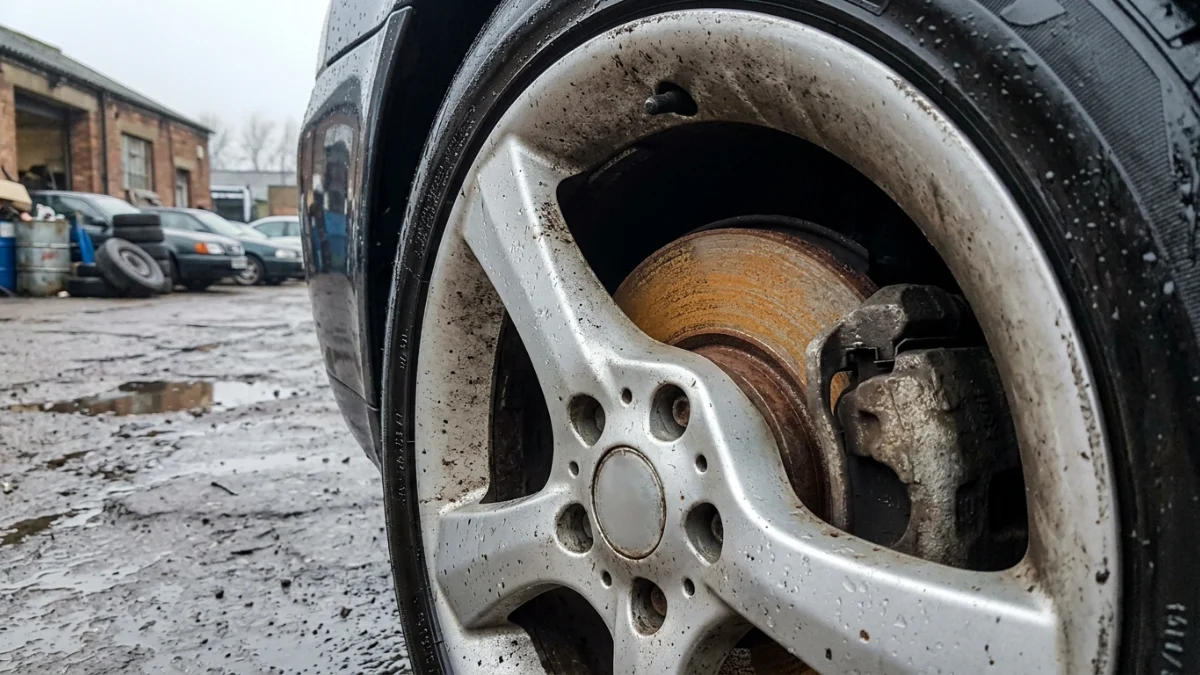
CF3 MOT and Service Centre traces a brake fault by measurement rather than description. The car is road tested with your account of the symptom written down, then pad thickness, disc thickness, slide pin movement and fluid moisture go on the job sheet.
Braking efficiency and imbalance are measured on a roller brake tester. Our guide to what an MOT checks sets out how a defect becomes an advisory, a major or a dangerous item, and a pre-MOT check catches a brake imbalance or a corroded pipe in time.
CF3 is a DVSA approved test station and an all makes garage at Unit 4C Wentloog Buildings, Wentloog Road, Rumney, Cardiff CF3 1TH, minutes from St Mellons, Llanrumney and the A48.
Brake noise and brake feel questions
Is it safe to drive with squealing brakes?
A squeal that clears within a few stops on a cold morning is safe, because it is surface rust coming off the discs. A squeal still there once the brakes are hot means a wear indicator is on the disc or the pad has glazed, so book it within days.
Why do my brakes squeal in the morning and not later?
Cast iron disc faces oxidise overnight, faster when the car was parked wet and salty. The pads scrub that film off within a few applications, so the squeal fades as the discs clean up and the brakes warm. The effect is strongest on cars kept outside.
Do brake discs have to be replaced with the pads?
Discs are replaced with the pads when they reach the minimum thickness figure cast into the hub, when the face is scored, cracked or heat damaged, or when thickness varies enough to judder. A disc inside specification with an even face keeps the new pads.
Does the MOT check brake pads?
The MOT inspects pads, discs, hoses, pipes and the parking brake, and measures braking efficiency and imbalance on rollers. A brake pad worn below 1.5mm is a major defect under the DVSA MOT inspection manual. The tester may not repair anything, so a worn pad is only written up.
Why does the brake pedal go soft after heavy braking?
Brake fluid absorbs water from the atmosphere over time, and water boils at a far lower temperature than the fluid. Heat from repeated heavy stops turns that water to vapour, vapour compresses where fluid does not, and the pedal travels further. It firms up as it cools, which hides the fault.
Can an electronic parking brake be released without a diagnostic tool?
An electronic parking brake is wound in and out by a motor on each rear caliper, so releasing it for pad work needs a diagnostic tool to set service mode. Forcing the piston back damages the screw mechanism, and the same tool reads the fault that stopped the actuator.
Getting a straight answer on a brake noise
Every symptom here has a cause that can be seen or measured once the wheel is off, which is why a brake noise is worth naming rather than living with.
Say what you hear and when you hear it, because that decides what gets inspected first. Book the car into the garage in Rumney on 07400 454839, at Unit 4C Wentloog Buildings, Wentloog Road, Rumney, Cardiff CF3 1TH.
Find out what the brake noise actually is
Ring CF3 MOT and Service Centre on 07400 454839 with your registration, or book through the widget above. The wheels come off, the pads, discs, pins and fluid are measured, and the figures come first.

