
Book Online
07400454839
-
By: Ali Hindal
- 0 Comments
A knocking noise from the engine means a moving part is being struck, and the timing of that noise identifies which part, because a cold start rattle, a tick that follows the revs and a deep knock under load come from different places. You can hear it and still have no way of judging it. The one fact you can report accurately is when it happens. This guide sets out what each timing points at, what the workshop checks, and the one noise where driving on changes the size of the repair.
Engine knocking noises, at a glance
- The timing of the noise is the branch point. Cold start noise, noise that follows the revs and noise under load come from different mechanisms.
- A deep rhythmic knock low in the engine that rises with the revs and is getting worse is the one noise to stop for.
- A rattle for a second or two on start up points at a timing chain or wet belt tensioner that bled down overnight.
- A light tick from the top of the engine points at the valve train, a hydraulic lifter or a valve clearance.
- A knock only under load points at pre ignition, a fuel grade below the manufacturer figure, or carbon.
- A rattle at idle that changes with the clutch pedal is a clutch and gearbox noise, not an engine noise.
- Cold thick oil takes longer to reach the cylinder head, so start up noises are loudest on the first cold Cardiff mornings.
- Oil level and grade get checked first, because low oil makes every noise worse.

What a knocking noise from the engine actually means
A knock is metal arriving at metal with clearance between the two, so the noise says a gap has opened where a controlled fit used to be. Three families cover almost all of it. The valve train runs small clearances held by oil pressure, and a clearance that grows makes a light, fast tick. Belts, chains and their pulleys are held taut by a tensioner, and slack in them rattles. The bottom end carries the crankshaft, con rods and bearing shells on a pressurised film of oil, and a knock from down there means the film has gone.
Timing identifies the family because each answers to a different condition. Oil pressure builds in the first seconds after cranking. Oil viscosity falls as the engine warms. Combustion pressure climbs with load. A noise that comes and goes with one of those belongs to the mechanism that condition controls, which is why an engine diagnostics session opens with questions rather than a tool.
Not sure which of these noises you have
Record the noise on your phone on the next cold start, then again warm, and check the oil level before you set off. Ring CF3 MOT and Service Centre in Rumney on 07400 454839 and say when the noise starts and when it stops. That description decides what gets checked first.
Timing of the noise is the one thing you can report accurately
The timing of a noise is reliable information because you control the conditions that produce it. Each row below is a starting point for a check rather than a diagnosis, because several of these mechanisms make a similar noise.
| When you hear it | What it points at first | Driving |
|---|---|---|
| Only on a cold start, gone within seconds | Oil drained from the lifters overnight, or cold piston clearances | Raise it at the next service |
| Cold start, still there for the first few minutes | A lifter not pumping up, a worn follower, low oil or wrong oil grade | Book this week |
| A rattle for a second or two on start up, then clears | A timing chain or wet belt tensioner bleeding down overnight | Book this week, sooner on a wet belt |
| A light tick from the top of the engine, hot or cold | Valve clearance, a worn cam follower or a lifter | Book this week |
| Rising and falling with the revs, car stationary | The valve train, or a belt tensioner, idler, alternator or water pump bearing | Book this week |
| Only under load, up a hill or accelerating hard | Pre ignition, fuel grade below the manufacturer figure, carbon, or a knock sensor fault | Ease off and book this week |
| At idle, changing as the clutch pedal moves | A release bearing, a dual mass flywheel or a gearbox input shaft bearing | Book this week |
| A deep rhythmic knock low in the engine, getting worse | A big end bearing that has lost its oil film | Stop driving. Arrange recovery |
The detail behind each row follows, starting with the first turn of the key.
Cold start noises and what the first minute tells you
A noise that appears on a cold start and then changes is telling you about oil. Oil drains from the top of the engine while the car is parked, thickens as it cools, and takes time to climb back. How long the noise lasts is the measurement.
Only on a cold start, then gone within seconds
A tick that clears within seconds is the valve train running dry for a moment. Oil has drained back to the sump overnight, the hydraulic lifters have lost their charge, and the first pressure refills them. Cold piston clearances produce a similar brief rattle on some engines, loudest from the block. Both deserve a mention at the next service so the oil level and grade get checked.
Only on a cold start, and it stays for the first few minutes
A noise that persists for minutes points at oil supply rather than oil drain down. A lifter that will not pump up, a worn cam follower, a low oil level and an oil grade heavier than the engine was designed for all delay the point where the clearance closes. An exhaust manifold gasket starting to blow ticks until the metal expands and seals it, from the side of the head.
A rattle for a second or two on start up that then clears
A short rattle on start up points at a hydraulic tensioner on the timing drive that has bled down while the car was parked. The chain or belt sits slack, slaps the guide for the first turns, then quietens once oil pressure reaches the tensioner. Duration is the detail to watch. A rattle getting longer week on week means the tensioner is no longer holding, or the chain has stretched.
That noise carries more weight where the belt runs in oil. Knowing whether your engine has a wet belt or a dry cambelt changes the urgency, because a degrading wet belt sheds material that reaches the oil pick up in the sump. Wet belt replacement stays planned work only while the belt is intact. The next group of noises is defined by the revs rather than by temperature.
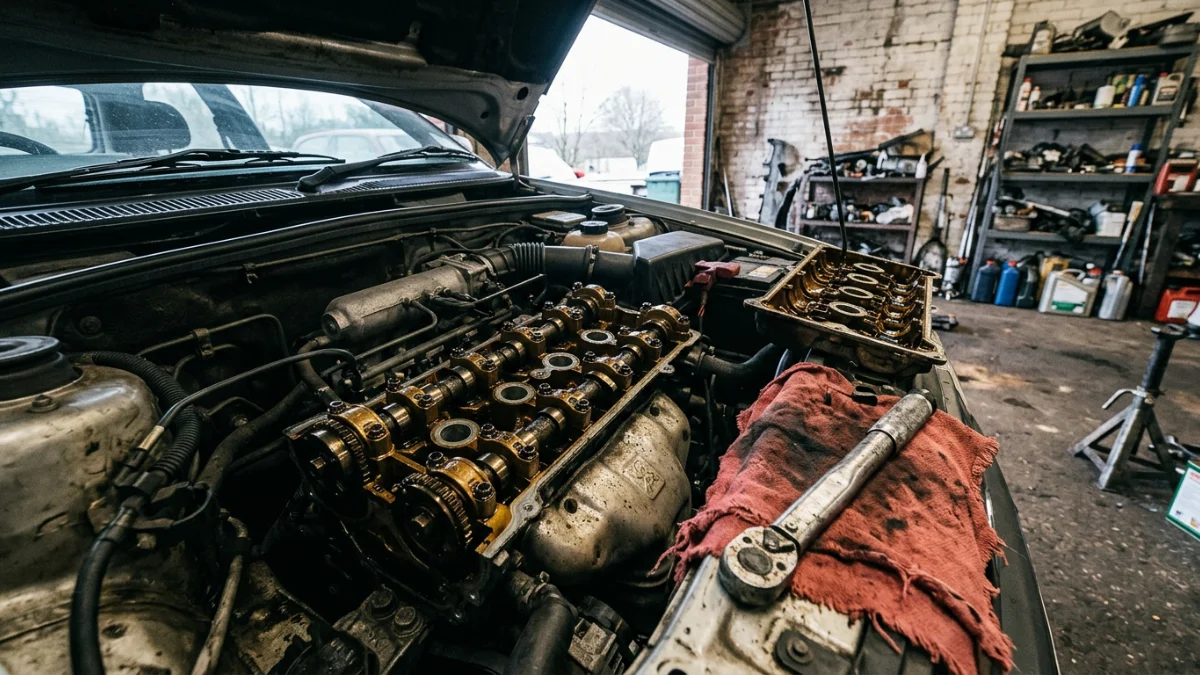
A tick or knock that rises and falls with engine speed
A noise that follows the revs with the car stationary comes from the engine or from something the engine drives, and that rules out wheels, tyres, brakes and driveshafts. A light, fast tick keeping pace with the camshaft is valve train. A deeper whirr or knock that rises with the revs often belongs to a bearing bolted to the front of the engine: the auxiliary belt tensioner, an idler pulley, the alternator or the water pump.
Separating the two takes one step. The auxiliary belt comes off and the engine runs briefly without it. A noise that disappears belonged to a belt driven component, and a noise that remains is inside the engine. Pulley and tensioner work sits with ordinary mechanical repairs. Load changes the picture again, which is where the next noise belongs.
A knock that appears only under load
A knock heard only when climbing a hill or accelerating hard is combustion noise rather than mechanical noise. Fuel and air are igniting ahead of the spark, and the pressure spike arrives against a piston that is still rising. The sound is a rapid metallic rattle from the top of the engine that stops the moment you lift off.
Four causes account for most of it: a fuel grade below the octane figure the manufacturer specifies, carbon deposits raising compression, over advanced ignition timing, and a failed knock sensor. The sensor matters most, because the management system normally retards timing the instant it detects knock. Audible knock under load means that correction has run out of authority or the sensor has gone, and the engine management light often has something to say even where the dashboard looks normal. Sustained pre ignition damages pistons and head gaskets. Not every knock that sounds internal is internal, which is the next distinction to make.
Noises that are not coming from inside the engine
Two common noises sound like engine faults and are not, and both get settled on the ramp. A rattle at idle in neutral that quietens as you press the clutch pedal points at a gearbox input shaft bearing or a dual mass flywheel, because pressing the pedal takes the drive apart and removes the engine pulses shaking those parts. A noise that appears as you press the pedal points at the release bearing instead. Either way the pedal is the switch and the noise lives in the bellhousing.
The second is a loose exhaust heat shield or bracket. A thin steel shield that has lost a fixing buzzes against the body or the exhaust at particular revs, and the result sounds far worse than the fault behind it. A cracked exhaust mounting rubber and a loose undertray fixing do the same, and both are cheap findings. The next noise is the opposite case.

A deep rhythmic knock that gets worse, the one noise to stop for
A deep rhythmic knock from low in the engine that rises with engine speed and has been getting worse is a big end bearing that has lost its oil film, and it differs from every other noise here because driving on makes the repair bigger. Stop the car, switch the engine off and arrange recovery.
A big end bearing shell rides on a pressurised film of oil around the crankshaft journal. Once the shell has worn through or the oil supply has fallen away, the shell contacts the journal and the clearance opens. Every revolution after that removes material from the journal, and the knock is the con rod arriving at the end of that clearance.
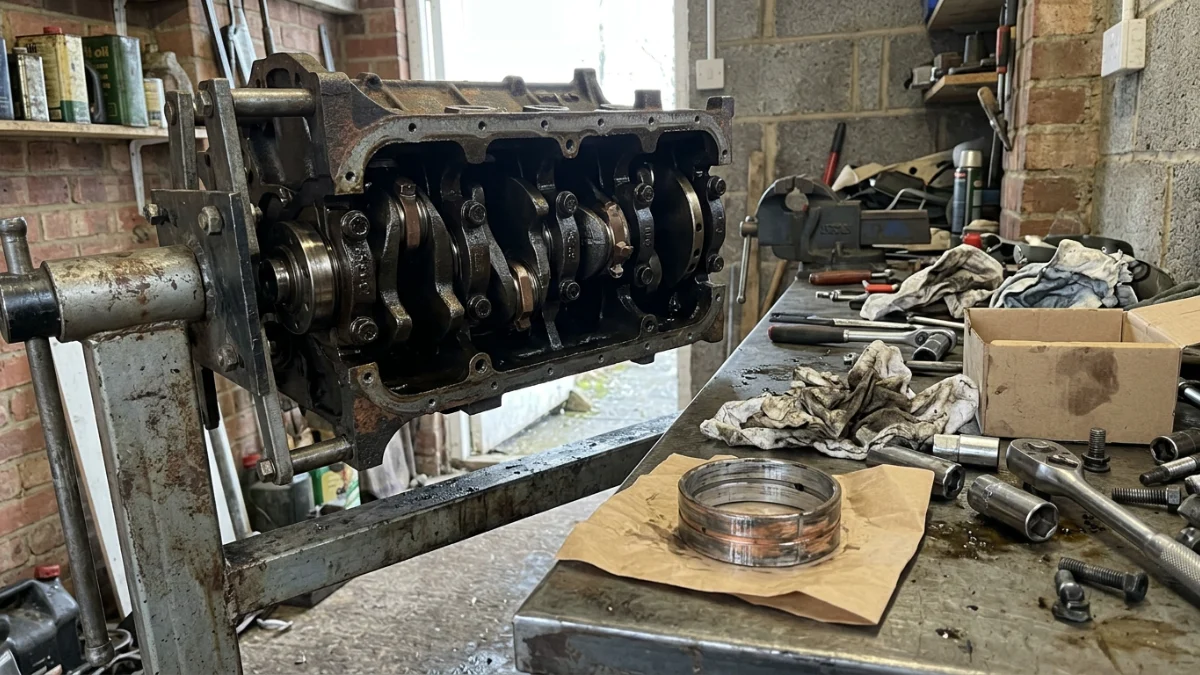
A bearing caught while the crankshaft is still within limits is a bearing job. A crankshaft run on a collapsed shell needs regrinding or replacing, debris circulates through the oil galleries and the pump, and the repair becomes a strip of the whole engine. The far end of that road looks like an engine lifted out and stripped on the bench. A low oil pressure warning light alongside the knock is not a reason to drive to the garage. Separating that knock from the rest is a sequence of checks rather than a judgement.
How a workshop finds the source of a knocking noise
A workshop finds the source by eliminating mechanisms in a fixed order, cheapest checks first, starting with those that change the urgency of what follows.
- Oil level and condition on the dipstick, and the grade in the sump against the manufacturer specification.
- Stored fault codes and live data: misfire counters per cylinder, knock sensor activity, camshaft to crankshaft correlation and oil pressure readings.
- A listen at defined points with a sounding rod. The cam cover, the block skirt, each ancillary bearing and the bellhousing give different answers.
- Auxiliary belt removal and a brief run without it, which separates belt driven noise from internal noise.
- A compression test, and a leak down test where the compression figures disagree with each other.
- A borescope through a plug hole, and a mechanical oil pressure gauge where the dashboard warning is in doubt.
- The oil filter cut open and the sump inspected for metal, which separates a bearing in trouble from one already gone.
A noise with a misfire shows why measurement beats listening. A compression test on a PureTech that came in misfiring turned a reported noise into a figure on a job sheet. That is the position on every knock: test before you quote, and the reading goes on the job sheet next to the price.
Get the noise identified before it decides for you
One booking covers the oil check, the code read, the listen at defined points and the belt off test, and you are told what each one showed. Bring the car to the Wentloog Road workshop in Rumney, or ask about recovery if the knock is deep. Ring 07400 454839 with your registration.
Why winter makes a knocking engine louder and longer
Cold oil is thicker oil, and thicker oil takes longer to climb from the sump to the cylinder head, so every start up noise that depends on oil arriving is at its loudest and longest on a cold Cardiff morning. Lifters that drained overnight take longer to refill, so a tick that lasted a moment in September runs on in January. A tensioner that bleeds down takes longer to pressurise, which is why a timing chain rattle nobody has noticed turns up on the first genuinely cold morning.
Oil level turns all of this from a noise into a fault. A sump down on oil has less to deliver and delivers it more slowly. A crankshaft seal leak on a V6 TDI is the kind of fault that quietly drops the level between services, and the noise that follows is a consequence rather than the fault. Checking the dipstick weekly through the winter is the cheapest thing on this page, and it belongs with the other winter car checks worth doing in December. Which of these noises you have decides whether the car can be driven at all.
Whether it is safe to keep driving with a knocking engine
Safety depends on which noise you have, and the honest answer splits three ways. Some noises are an inconvenience, most are a job to book inside the week, and one changes the size of the repair for every mile you add.
An inconvenience is a loose heat shield, a cracked exhaust mounting, a manifold gasket tick that seals as the engine warms, or a brief cold start tick that clears within seconds. Book it in and drive on in the meantime. A job for this week covers a tick that stays after warm up, a noise that follows the revs, a start up rattle that is getting longer, any new noise on a wet belt engine, a knock under load, and any noise on a car with a low oil level or a management light showing. Those faults progress, and waiting lets a contained repair spread into the parts around it, which is ordinary car repair work.
One noise is not a booking. A deep rhythmic knock low in the engine that rises with engine speed and is getting worse means the car should not be driven again. Switch the engine off and have the vehicle recovered. That is the single noise here where driving on turns a repair into an engine.
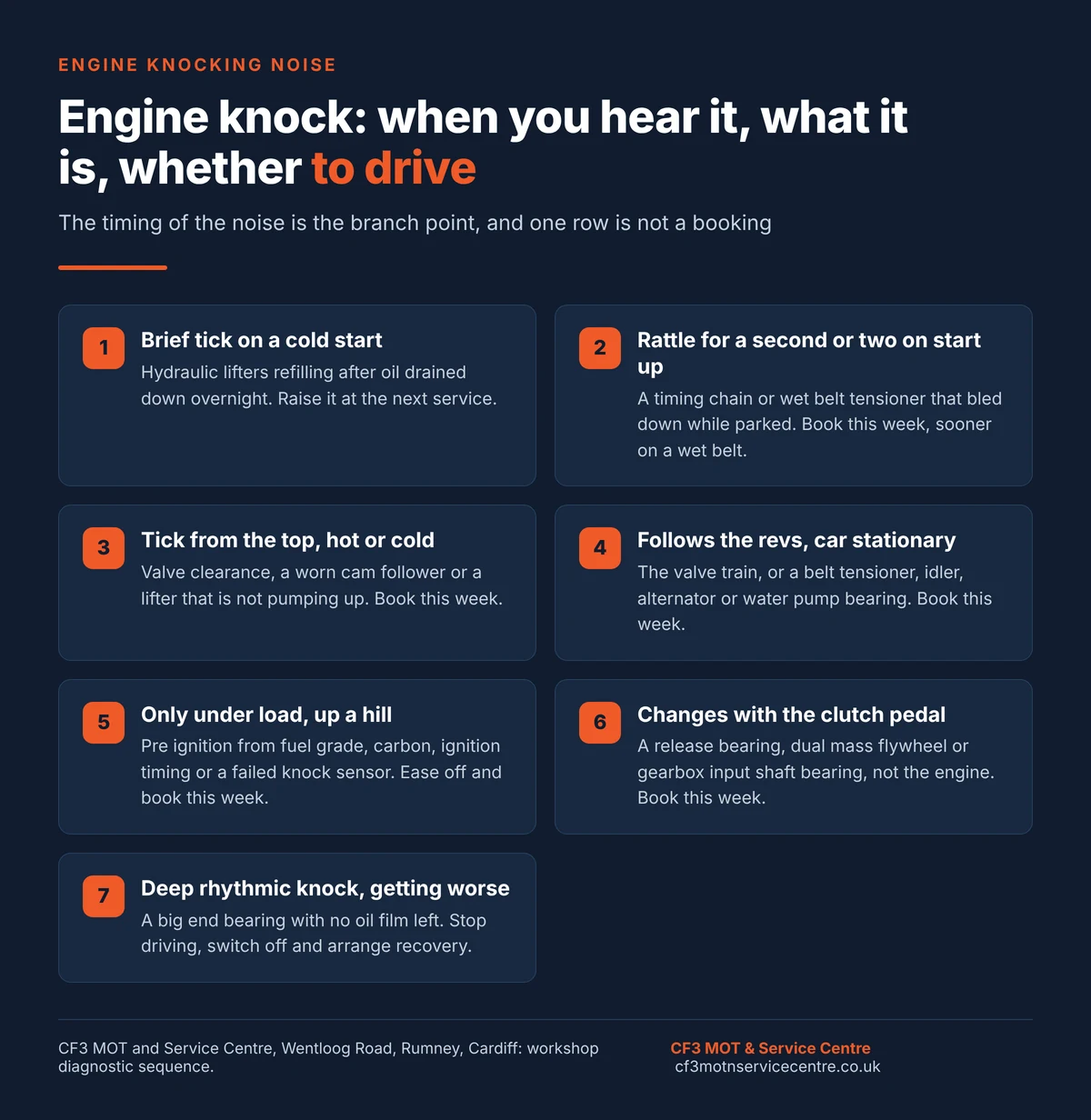
- Brief cold start tick: lifters refilling. Next service.
- Start up rattle that clears: chain or wet belt tensioner. This week.
- Tick from the top, hot or cold: clearance, follower or lifter. This week.
- Follows the revs, car stationary: valve train or belt driven bearing. This week.
- Only under load: pre ignition, fuel grade, carbon or knock sensor. This week.
- Changes with the clutch pedal: clutch or gearbox, not the engine. This week.
- Deep rhythmic knock, getting worse: big end bearing, no oil film. Stop and recover.
CF3 MOT and Service Centre is a DVSA approved test station and an all makes garage at Unit 4C Wentloog Buildings, Wentloog Road, Rumney, Cardiff CF3 1TH, five minutes off the A48 and a short run from St Mellons, Llanrumney, Newport Road and the M4. Cars, vans, fleet vehicles and motorhomes come in for noise diagnosis. Ring 07400 454839 and say when you hear it.
Engine knocking questions
Can I keep driving with a knocking engine?
A light tick or a brief cold start rattle can be driven to a booked appointment without adding damage. A deep rhythmic knock from low in the engine cannot, because every revolution removes material from the journal. The test is whether the noise is deep, rhythmic and getting worse, which means recovery.
Does low oil cause an engine knocking noise?
Low oil causes knocking noises directly and makes every other noise worse. A level below the minimum mark means air drawn in with the oil, slower pressure build and a thinner film at every bearing and lifter. Check the dipstick before you book, because that observation changes what gets checked first.
Why does my engine only knock when it is cold?
A cold engine knocks because oil has drained back to the sump overnight and cold oil is thicker, so it takes longer to refill the lifters and pressurise the timing chain tensioner. Clearances are also widest before the engine reaches operating temperature. A noise that clears as the engine warms is normal on some engines and a warning on others.
Can an oil and filter change stop a knocking noise?
An oil and filter change stops a knock caused by a low level, degraded oil or the wrong grade, and nothing caused by worn metal. A lifter sticking on dirty oil often quietens within minutes on fresh oil of the correct specification. A car service is the right first move where the oil is overdue.
The engine knocks while cranking and will not start. What does that mean?
A heavy knock or grind while cranking usually points at the starter motor, the flywheel ring gear or a battery too flat to turn the engine, rather than an internal fault. Cranking voltage under load is the first reading to take. Our guide to a car that will not start covers the drop test.
Does higher octane fuel stop knocking under load?
Higher octane fuel stops knocking under load where the engine was specified for it and has been run on a lower grade. Octane describes resistance to pre ignition, so meeting the manufacturer figure removes one cause. A knock that continues on the correct grade points at carbon, ignition timing or a knock sensor.
Getting a knocking noise diagnosed in Rumney
A knocking noise has an honest answer, and it comes from readings rather than a guess at the counter. Oil level, stored codes, a listen at defined points, a belt off test and a compression figure take the question from a description to a diagnosis.
Describe the timing when you ring. Say whether the engine was cold, whether the car was moving, whether you were accelerating and whether the clutch pedal changed anything. Ali, the owner and lead technician, works through the sequence and reports what each check showed before any repair is authorised.
Book your car into the workshop at Unit 4C Wentloog Buildings, Wentloog Road, Rumney, Cardiff CF3 1TH on 07400 454839, or use the booking widget above. Evening and Saturday appointments and vehicle recovery are available subject to availability.
Tell the workshop when the knock happens
Ring CF3 MOT and Service Centre in Rumney on 07400 454839 with your registration and the timing of the noise, or use the widget above. Test before you quote, and the reading goes on the job sheet next to the price.

