
Book Online
07400454839
-
By: Ali Hindal
- 0 Comments
Your car runs a wet belt when the engine is on a short list, and that list is short enough to check in a minute: Ford 1.0 and 1.5 EcoBoost petrol from 2012 to 2020, the Ford Puma 1.0 EcoBoost from 2019 to 2020, the Stellantis 1.2 PureTech from 2014 to 2023, the Honda Civic 1.0 VTEC Turbo from 2017 to 2021, the Ford 2.0 EcoBlue diesel from 2016 on, VW Group 1.6 and 2.0 TDI units, and the Volvo 2.0 D-series from 2015 on. Most other engines run a dry belt behind a timing cover, or a steel chain.
No badge on the boot lid tells you which one you have. So here are the checks in order: where your engine code lives on the V5C and under the bonnet, the petrol and diesel lists with the years, which engines went back to a chain, how to read a service book entry, and what the risk is when nobody has raised it with you.
Already know your engine is on the list?
Book it in for wet belt replacement on a belt in oil engine, which takes the old belt out before it sheds into your oil pump, at our six bay workshop on Wentloog Road in Rumney.
Wet belt engines, at a glance
- A wet belt runs inside the engine in the oil, so it cannot be inspected without stripping the front of the engine or dropping the sump.
- Affected petrol engines: Ford 1.0 and 1.5 EcoBoost 2012 to 2020, Ford Puma 1.0 EcoBoost 2019 to 2020, Stellantis 1.2 PureTech 2014 to 2023, Honda Civic 1.0 VTEC Turbo 2017 to 2021.
- Affected diesels: Ford 2.0 EcoBlue from 2016, VW Group 1.6 and 2.0 TDI, Volvo 2.0 D-series from 2015.
- Several of those diesels drive the oil pump off a second belt that sits in the sump, and it is often forgotten at belt change time.
- Lifetime is no longer the guidance. Revised figures are 6 years or 62,000 miles on PureTech, 7 to 8 years or 80,000 miles on Ford EcoBoost, and 6 years or 100,000 miles on Ford EcoBlue under 2024 guidance.
- The failure is not a snapped belt, it is delamination, with rubber debris blocking the oil pump pickup and starving the engine of oil pressure.
- Build date decides it, not the registration plate or the facelift
What is a wet belt, and how is it different from a normal cambelt?
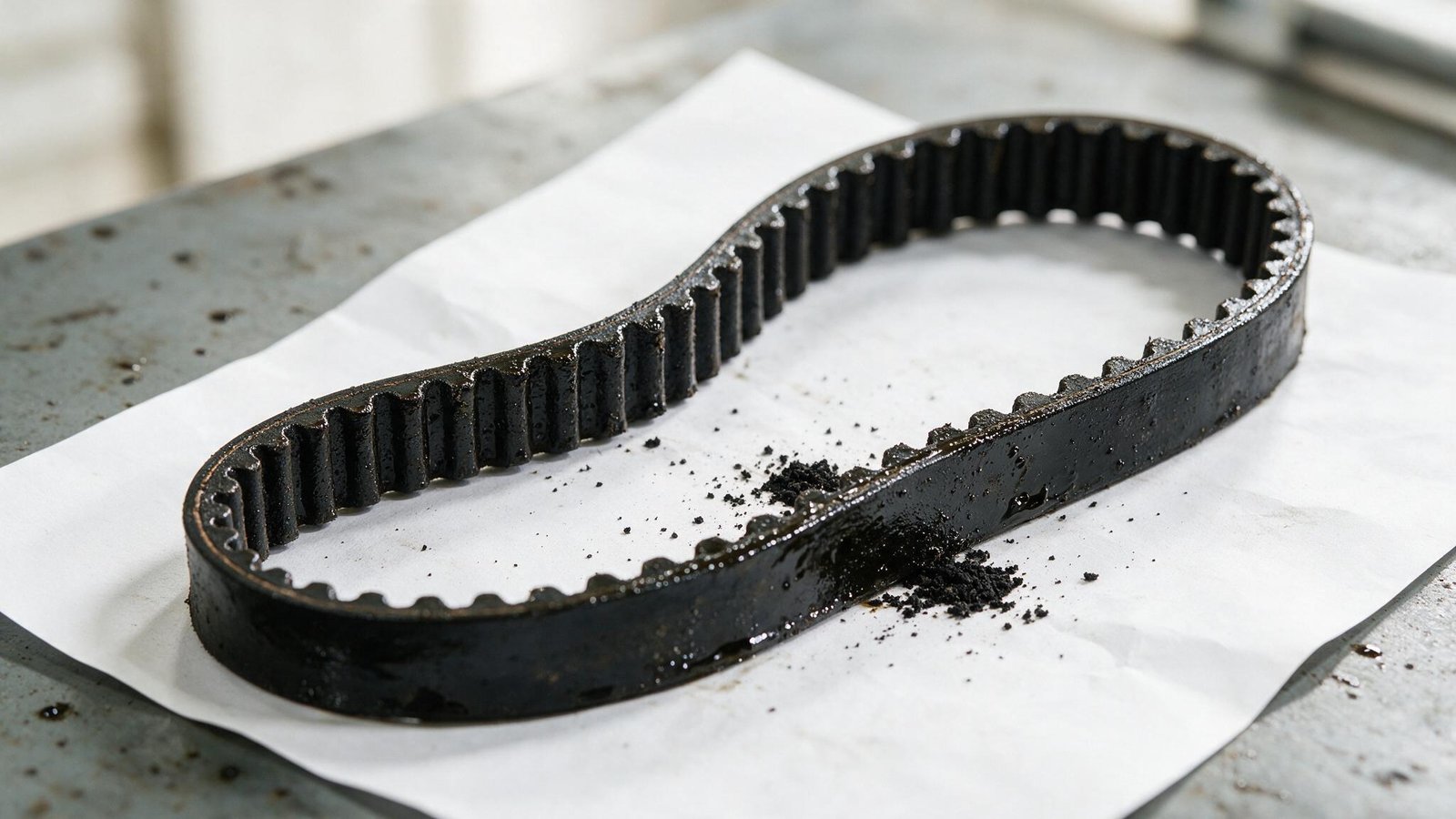
A wet belt is a toothed rubber timing belt that runs inside the engine, bathed in the same engine oil that lubricates the crankshaft and camshafts. Manufacturers call it a belt in oil, and it reached production because it is quieter than a chain and drags less than a dry belt.
A conventional dry belt sits outside the engine behind a plastic timing cover, kept away from oil, driven off the crankshaft pulley and held under load by a tensioner. Take the cover off and you can see the belt, the teeth, and the condition of the tensioner and idlers. That is why cambelt replacement on a dry belt engine is planned, predictable work rather than an emergency.
You get none of that with a belt in oil. There is no cover to lift. The belt sits behind the front of the engine, sealed against the oil galleries, and on several engines a second belt runs down in the sump driving the oil pump. Seeing it means stripping the engine front, and by then you may as well replace it.
Timing chains are a different animal. A chain is steel, built to run in oil, and it does not shed material into the sump the way a degrading rubber belt does. Chains wear in their own way, mainly stretch, guides and tensioners, but a chain engine is not a wet belt engine.
How do I find my engine code on the V5C and under the bonnet?
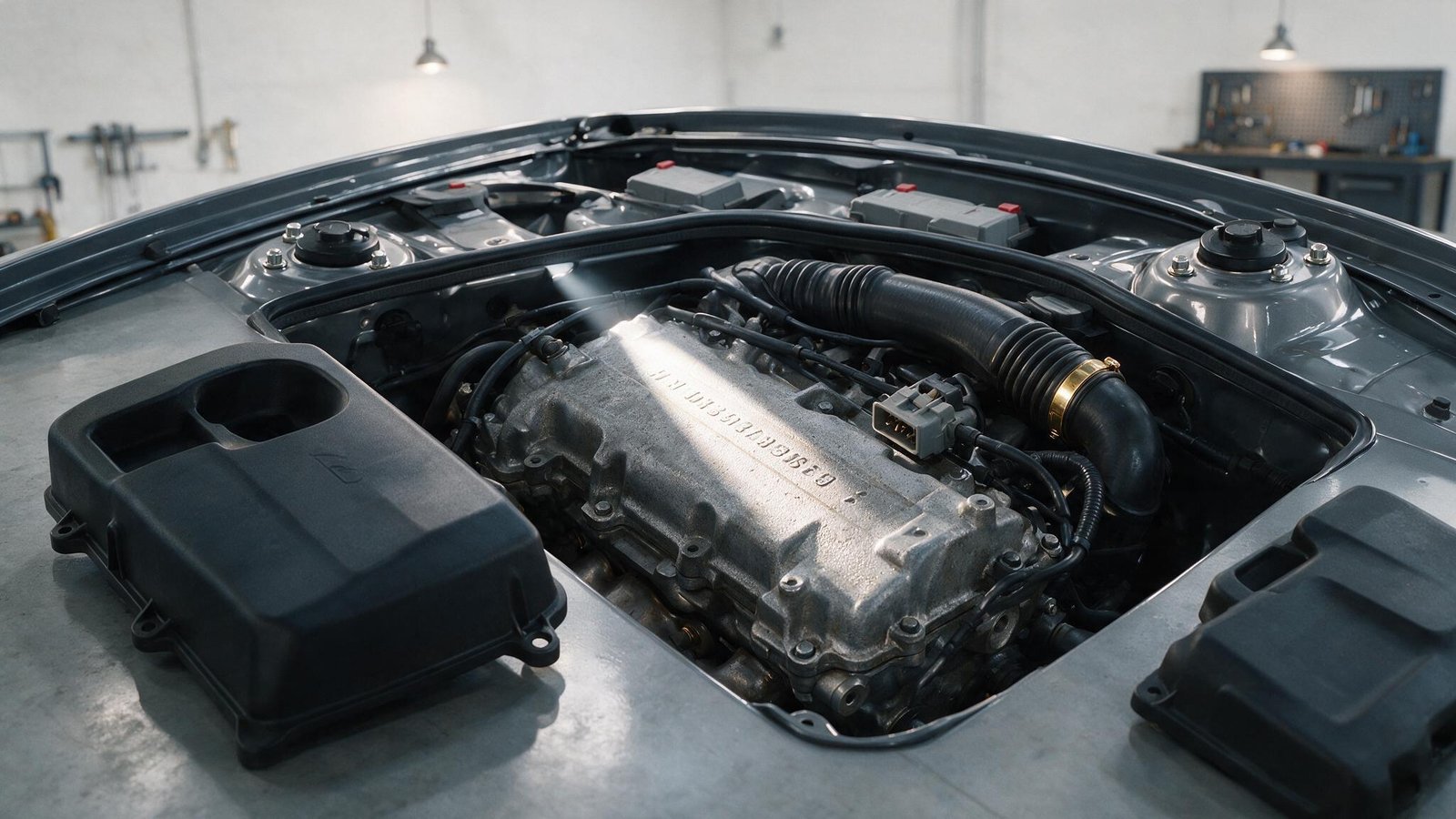
Start with the V5C logbook, because it narrows things down in seconds even though it will not name the engine family outright. Field D.1 gives the make, D.2 the model and variant, field E the VIN, P.1 the engine capacity in cc and P.3 the fuel type. There is also a box labelled engine number.
Be careful with that box. It holds the serial number stamped on your engine, which often carries the family code inside it but is not the same as the manufacturer’s engine code. Capacity plus fuel gets you close: 1199cc petrol on a Peugeot, Citroen, Vauxhall or DS points hard at the 1.2 PureTech, 999cc petrol on a Ford at the 1.0 EcoBoost, 1997cc diesel on a Ford from 2016 at the 2.0 EcoBlue.
Under the bonnet it goes marque by marque:
- Ford EcoBoost petrol codes read like M1JU, usually on a label or stamped area on the engine itself rather than on the plastic top cover.
- Ford diesel codes such as YZDA identify the 2.0 EcoBlue, and the plastic cover has to come off on most of them.
- Stellantis stamps the turbocharged 1.2 PureTech as EB2DT or EB2DTS, near the gearbox end of the block.
- Volvo uses a code in the B4204T style, stamped on the block face.
The sticker in the driver’s door shut is worth a look, but manage your expectations. It carries the VIN, the paint code, tyre pressures and often an option code list, and it rarely names the engine family.
Nothing legible left? Quote the VIN to a main dealer parts desk for the build record, or bring the car to us and we take the code from the engine control unit during engine diagnostics that read the code straight from the ECU, which settles it without guesswork.
Which petrol engines use a wet belt, and in which years?
These are the petrol engines that run a belt in oil, with the years that apply:
- Ford 1.0 EcoBoost, 2012 to 2020. Fiesta, Focus, B-Max, C-Max, EcoSport and Mondeo.
- Ford Puma 1.0 EcoBoost, 2019 to 2020.
- Ford 1.5 EcoBoost, 2012 to 2020. Focus, Mondeo and Kuga.
- Stellantis 1.2 PureTech, 2014 to 2023. Peugeot 208, 2008, 308, 3008 and 5008. Citroen C3, C4 and C3 Aircross. Vauxhall Corsa, Mokka, Crossland and Grandland. DS 3.
- Honda Civic 1.0 VTEC Turbo, 2017 to 2021.
Two things trip people up. The first is the plate. A car registered in March 2021 can easily have been built in late 2020, and the build date decides which engine went in.
The second is engine size on its own. Vauxhall’s move onto Stellantis engines means an older Corsa and a 2020 Corsa are mechanically unrelated cars wearing the same name, and the 1.0 badge on a Fiesta covered both the non turbo three cylinder and the EcoBoost. Match the code, not the badge.
Anything not on that list, we do not treat as a wet belt engine. There is a lot of loose talk online about engines being added, and we are not going to repeat it as fact.
Which diesel engines use a wet belt?
Three diesel families matter, and one of them catches people out in a way the petrols do not:
- Ford 2.0 EcoBlue, 2016 on. Transit, Transit Custom, Ranger, Focus, Kuga, Mondeo, S-Max and Galaxy.
- VW Group 1.6 and 2.0 TDI, the EA288 generation. Golf, Polo, Passat and Caddy, plus the Audi, Skoda and Seat equivalents.
- Volvo 2.0 D-series, 2015 on.
Here is the part that gets missed. On the VW Group TDI units, the belt driving the camshafts is a dry belt behind a cover, as it always was. The wet element is a separate toothed belt inside the engine driving the oil pump, with its own service life. A garage can change the cam belt on one of these, hand the car back with a clean invoice, and leave the oil pump drive belt untouched.
That is the belt whose failure hurts most, because when it goes the oil pump stops turning. The oil pressure light comes on and the damage begins in the seconds that follow.
Ask any garage quoting a belt job on a diesel in this group one direct question: is the oil pump drive belt included. A yes gets a part number on the invoice. A blank look tells you what you need to know.
My car is newer: has the engine moved back to a chain?
Stellantis moved the newer EB2 1.2 to a chain from 2023, so a Peugeot 208, Citroen C3, Vauxhall Corsa or Vauxhall Mokka built from that point on the current engine runs a chain and sits outside the belt in oil interval. That is the one clean cut-off in this subject.
Cars built either side of the changeover sat in compounds and showrooms for months, so a 2023 registration is not proof of a chain and a 2022 registration is not proof of a belt. Get the build date off the VIN and get the engine code read.
Facelifts mislead people constantly. A facelift changes lights, bumpers, grilles and screens on a schedule set by the marketing calendar, not the engineering one. Never take a new dashboard as evidence of a new engine.
Ford is a different story. The affected span for the EcoBoost petrols runs 2012 to 2020 and the EcoBlue diesel from 2016 onwards, and we are not going to tell you a later Ford is automatically safe. Check the code and the build date.
How do I check my service book for a belt that has already been done?
Look for a dated entry naming the timing belt or cambelt kit with a mileage against it, then look at the detail behind it. A proper record shows the date, the mileage, the parts fitted with part numbers, and on the affected diesels a separate line for the oil pump drive belt. Wording like belt done is not a record, it is a note.
Digital records complicate this. Many franchised networks stopped stamping books years ago, so an empty book proves nothing. Ring the network, quote the VIN and ask for a print of the digital history before you spend money on work that may already have been done.
What to look for on the invoice itself:
- The kit part number, not just the word kit.
- The water pump, often driven by the same belt, and the tensioner and idlers, as separate lines.
- An oil and filter change immediately after, because a belt job that leaves contaminated oil in the engine has undone half its own work.
- The oil pump drive belt, where the engine has one.
A stamp with no detail leaves you assuming the work was not done. Harsh, but the cost of assuming the other way is an engine. Bring the book and the invoices to your next car service where we check the belt history against your engine code, and we will tell you plainly where you stand.
A Ford Transit Custom used by a small building firm in St Mellons came in for a clutch, and the 2.0 EcoBlue had covered a shade under 90,000 miles from new in 2017. The owner produced an invoice from another garage showing a timing belt kit fitted the previous year, which looked like a closed subject. The invoice listed the kit, the tensioner and a water pump, and nothing else. No oil pump drive belt, no part number for one. With the gearbox already out for the clutch, access to the front of the engine was better than it would ever be again, so the oil pump belt was done at the same visit for a fraction of the disruption it would have caused as a standalone job. The belt that came out was six years old and had never been touched. Sequencing work like that is the difference between two bills and one.
What if my engine is affected and nobody has ever mentioned it?
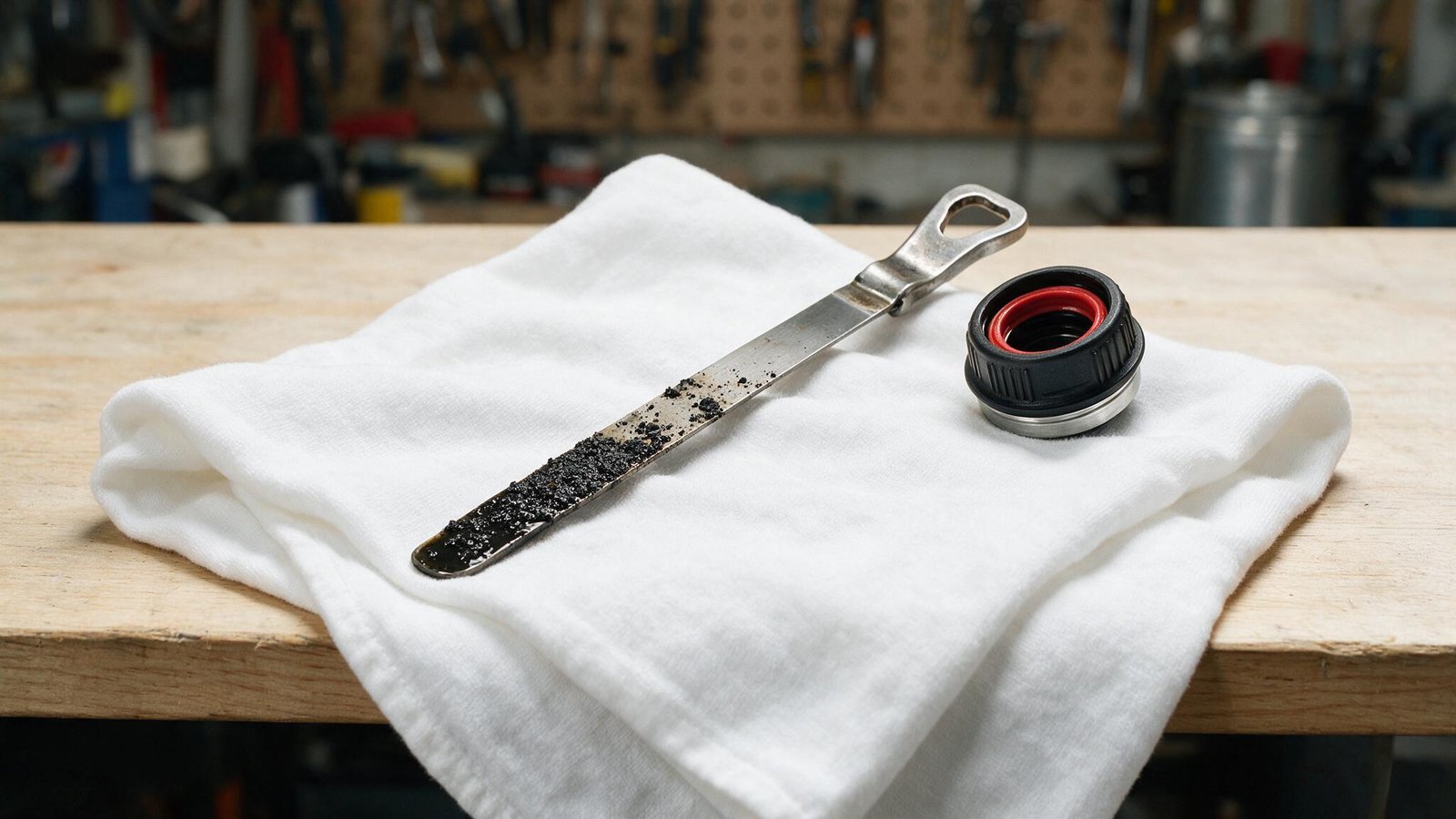
An affected engine past the revised interval with no record of a belt change is running on borrowed time, and the risk is not the one most drivers picture. These belts rarely snap. They delaminate, shedding fine rubber into the oil, and that debris blocks the oil pump pickup screen in the sump. Oil pressure falls, bearings and camshafts run dry, and the engine destroys itself from the inside while the belt is still turning.
Warning signs worth acting on today:
- The low oil pressure light, at any time, even briefly on a roundabout.
- A rattle on start-up from cold that clears after a few seconds.
- The car dropping into limp mode.
- Oil that looks thick, black and grainy on the dipstick, or shows rubber flecks on the filler cap or in the drained oil.
Pull the dipstick tonight while the engine is cold. Wipe it on kitchen roll and hold it to the light. Oil a few thousand miles old looks dark but smooth. Oil carrying belt material has a texture to it.
Driving on with a low oil pressure light turns a manageable job into a replacement engine or engine repair work after a belt has broken up. Stop the car, do not restart it to get a bit closer to home, and call us on 07400 454839. We run 24 hour recovery and would far rather collect it than have you drive it in.
The dealer told me it is lifetime. Is that right?
No, and that advice is out of date rather than dishonest. Lifetime was the original guidance on several of these engines, it did not survive contact with the real world, and the manufacturers revised it. The figures now are 6 years or 62,000 miles on the Stellantis 1.2 PureTech, 7 to 8 years or 80,000 miles on the Ford EcoBoost petrols, and 6 years or 100,000 miles on the Ford 2.0 EcoBlue under 2024 guidance.
Whichever comes first is the one that counts, and for most Cardiff cars that is the years.
Stellantis went further. Since March 2024 a warranty extension has covered parts and labour on the PureTech to 10 years or 180,000 km, with conditions attached. A separate compensation portal accepts UK claims for repairs paid for between 1 January 2022 and 31 December 2024, requires servicing that complied with the schedule, and requires the repair to have been carried out by an authorised dealer, which shuts independents out of that claim path. We will tell you when a car in front of us looks like a dealer conversation rather than ours.
Keep one thing separate in your head. Stellantis also has a recall covering roughly 44,000 UK cars from the 2023 to 2026 model years, for a fire risk caused by clearance between the petrol particulate filter pipe and the 48V belt starter generator. That recall has nothing to do with wet belts.
Ford owners have less to work with. There is no UK safety recall on the EcoBoost wet belt, Ford handles cases as case-by-case goodwill, and the class action running in the United States confers no rights on you here.
Which common Cardiff cars are affected?
The affected engines sit in ordinary cars, which is why the list matters locally. Ford Fiesta, Ford Focus and Ford Puma, Peugeot 208, Citroen C3 and Vauxhall Corsa are among the most numerous cars on the roads around Rumney, Llanrumney and St Mellons, and the wet belt engines went into all of them during the years they sold hardest.
Local mileage patterns make the picture worse rather than better. A car doing the school run in Trowbridge, a shop in Pentwyn and a commute down Newport Road covers short distances on an engine that never fully warms through. Oil takes longer to reach temperature, condensation and fuel dilution stay in it, and every trip is another cold start. The belt ages on time and start cycles, not motorway miles.
So the local car most at risk is not the high mileage one. It is the tidy 2017 or 2018 hatchback with a modest total on the clock, one owner, full history in the sense of oil changes, and no belt entry in the book. The owner reads low mileage as low risk. On these engines the years have already run out.
We see the PureTech and the 1.0 EcoBoost more than anything else here, and the pattern repeats: nobody had told the owner the belt was a service item.
A driver in Llanrumney bought a five year old Citroen C3 with a full stamped book and around 34,000 miles on it. Nothing felt wrong with it. She rang after reading that the 1.2 petrol had a belt problem, and the engine code came back as EB2DT, which put it squarely in the 2014 to 2023 wet belt span. Every stamp in the book was an oil service. Not one mentioned the belt, and the digital record from the franchised network said the same. On age alone the car was past the 6 year figure, with the mileage nowhere near 62,000. Her oil looked dark but clean on the dipstick, no rattle, no warning light, so the belt had not started shedding yet. That is the ideal moment for the job rather than the worst one: a planned replacement with the sump cleaned and fresh oil in, instead of a recovery truck and a stripped engine.
How do I get mine checked and priced?
The check is short and you get a straight answer at the end of it. We read the engine code from the ECU, cross reference the build date from the VIN, go through the service book and any digital record for a belt entry, then inspect the oil for debris, listen to it start from cold and watch oil pressure on live data. Three outcomes come out of that: not an affected engine, affected and already done, or affected and due.
On cost, what you want is not a number on a web page, it is an itemised quote for your engine. Ask any garage, including us, to break it out. What moves the figure is the engine and how much has to come off the front of it, whether the oil pump drive belt is included where one is fitted, whether the water pump is done at the same time, whether the sump comes off to be cleaned, and the tensioner, idlers, seals, oil and filter that go back with it. Two quotes that look different usually differ on that list rather than on labour.
Call us on 07400 454839 with your registration to hand and we will tell you on the phone whether your engine is on the list. We collect and deliver across CF3, CF23, CF24 and out as far as CF15, courtesy cars are available, and the workshop runs into the evening on several days.
Get a straight answer on your own car
Ring CF3 MOT & Service Centre on 07400 454839 with your registration, or book a belt in oil inspection and replacement at our Rumney workshop to have the belt out before it takes the oil pump with it. We are on Wentloog Road in Rumney, we collect and deliver across Cardiff, and we will tell you honestly when your engine is not affected.
Wet belt questions, answered
Is a wet belt the same as a cambelt?
A wet belt is a cambelt, it just runs inside the engine in the oil instead of outside behind a plastic cover, which changes how it fails and how it has to be serviced. A dry cambelt can be inspected by removing the cover. A wet belt cannot be seen without stripping the front of the engine, and it degrades by shedding rubber into the oil rather than by cracking in the open air.
Can a wet belt be inspected without taking the engine apart?
Not directly, and any garage claiming to inspect one visually without stripping the front of the engine is not doing what it says. What can be checked is the evidence around it: the oil condition on the dipstick and in the drained oil, debris in the filter, oil pressure on live data, cold start noise, and the service history against the revised interval for your engine code.
What happens if a wet belt fails?
The belt delaminates, the rubber debris blocks the oil pump pickup in the sump, oil pressure collapses and the engine damages itself through oil starvation, often within a very short distance of driving. That is why the low oil pressure warning light on an affected engine means stop, not carry on gently. Recovery is cheaper than a replacement engine every time.
My car has a timing chain, do I need to worry about this?
No, a chain engine is outside this issue entirely, because a steel chain is designed to run in oil and does not shed material into the sump the way a degrading rubber belt does. Chains have their own wear items, mainly stretch, guides and tensioners, and those are worth checking on any high mileage car. They are simply a different job with a different symptom set.
How do I know for certain which engine my car has?
Read the engine code, either from the stamping or label on the engine itself, from the build record a main dealer parts desk can pull using your VIN, or from the engine control unit with a diagnostic scan. The V5C narrows it down through the capacity in P.1 and the fuel type in P.3, but the code is the only thing that settles it. Bring us the registration and we will confirm it.
Find out tonight whether your engine is on the list
Ring CF3 MOT and Service Centre on 07400 454839 with your registration to hand and we will tell you on the phone whether your engine runs a belt in oil. We are on Wentloog Road in Rumney, we collect and deliver across CF3, CF23, CF24 and out to CF15, and we will tell you honestly when your engine is not affected.
