Book Online
07400454839
-
By: Ali Hindal
- 0 Comments
An interim service covers the oil and filter plus the safety checks, a full service adds the air filter, a deeper brake inspection and the suspension, exhaust, battery and cooling checks, and a major service adds longer interval items such as spark plugs.
The booking screen asks which service you want and says little about what separates the three. You are picking a level without seeing the list behind it.
This page sets out what each level includes, what every step up adds, and how to work out which one your car is due. The handbook, the last service sheet and how the car is driven decide it.
Interim, full and major servicing in Cardiff, at a glance
- An interim service is the oil and filter change, fluid levels, lights, tyres, a visual brake check and the safety walk round.
- A full service adds the air filter, measured brakes, suspension and steering, the exhaust, battery condition, belts, hoses and cooling.
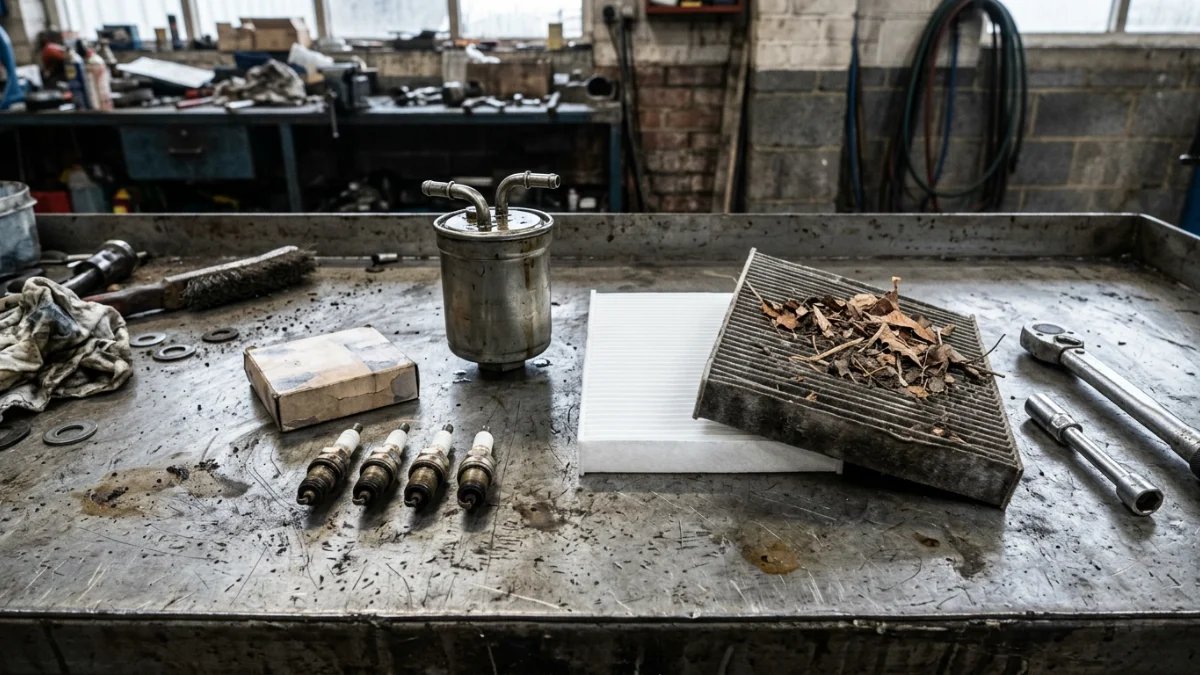
- A major service adds the long interval items: fuel filter, spark plugs on petrol, cabin filter, brake fluid and coolant condition.
- The level your car is due comes from the schedule, the time since the last oil change and what the last sheet left undone.
- Short cold journeys around Rumney and east Cardiff leave moisture and fuel dilution in the oil, so time governs, not mileage.
- A service is not an MOT, and it does not repair a fault the car already has.
- New oil poured through a full filter carries the last service’s debris.
What is the difference between an interim, full and major service
The difference is scope. An interim service is the oil and filter change with the safety checks. A full service covers that and inspects the systems that wear more slowly. A major service covers the full service and renews the parts on a long interval.
None of the three names is defined in law, so the itemised list on the job sheet settles what you are buying. CF3 sets out the levels on its car servicing in Cardiff page. Scope reads more clearly one level at a time.
What is included in an interim service
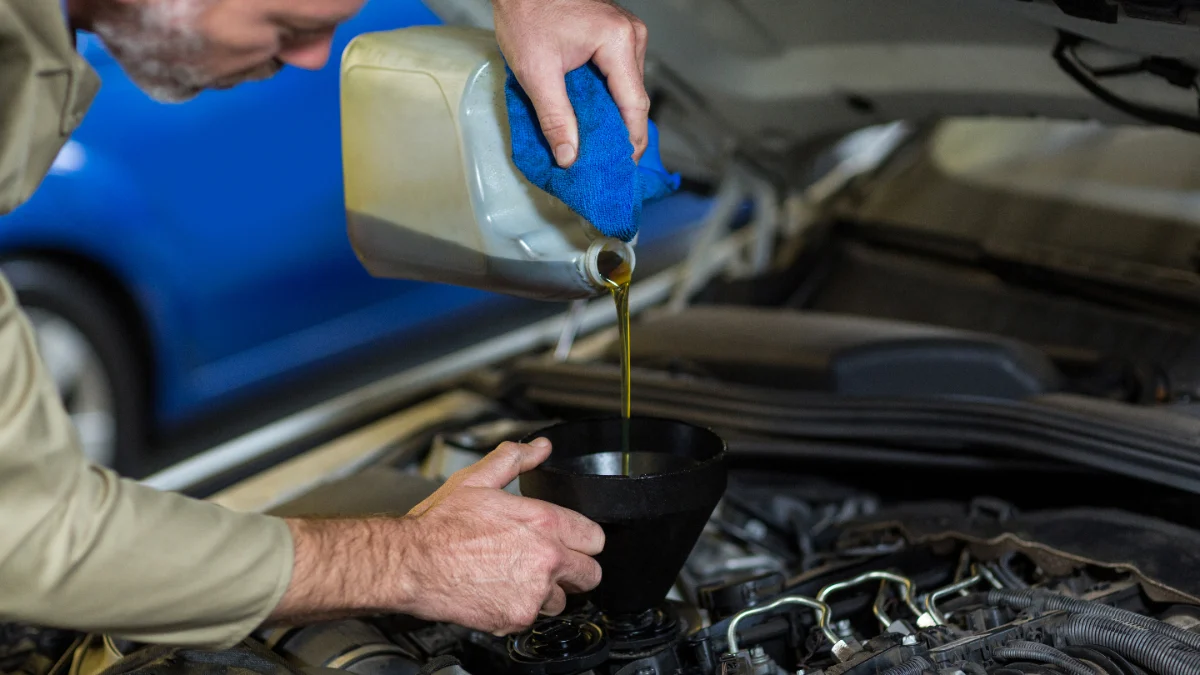
An interim service renews the engine oil and the oil filter, checks and tops the fluid levels, checks every exterior lamp, checks tyre tread, pressures and sidewalls, inspects the brakes visually, and completes the safety walk round.
The oil goes back in to the grade the manufacturer specifies, and the brakes are seen rather than measured, because the wheels stay on.
The interim level suits a car covering high mileage between annual visits, where the oil is finished before the rest of the schedule falls due. It carries no deep inspection, and that is the step up to a full service.
Not sure which of the three your car is due?
Read the registration and the date on the last service sheet to CF3 in Rumney, and the garage will say which level the schedule calls for.
What a full service adds over an interim service
A full service adds the air filter, a far more thorough brake inspection, the suspension and steering, the exhaust, battery condition, the drive belts, hoses and the cooling system, on top of the interim list.
Most additions are readings rather than parts. Pads and discs are measured, so the friction material left is written down as a figure. Joints, bushes and gaiters are checked for play and splits, the exhaust for leaks and loose mountings.
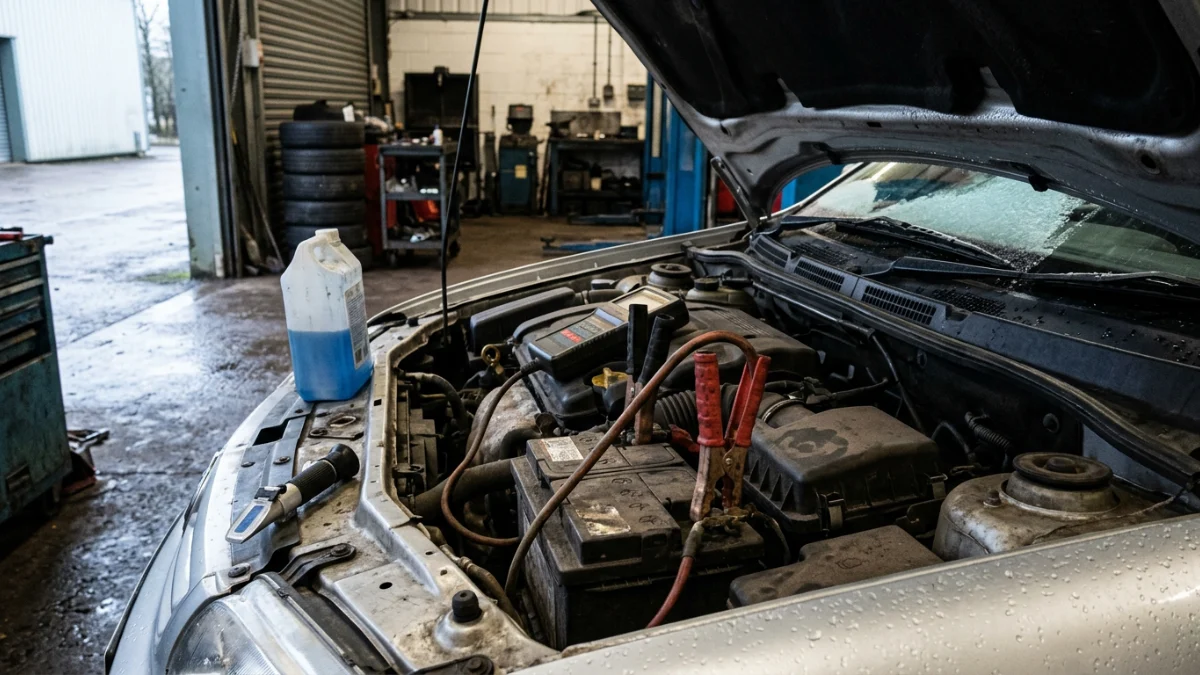
Three are winter checks. Battery condition is tested under load, so the cranking voltage on the drop test shows whether the battery will turn a cold engine. The auxiliary belt and tensioner are checked for cracking, and coolant strength is tested rather than assumed.
What a major service adds over a full service
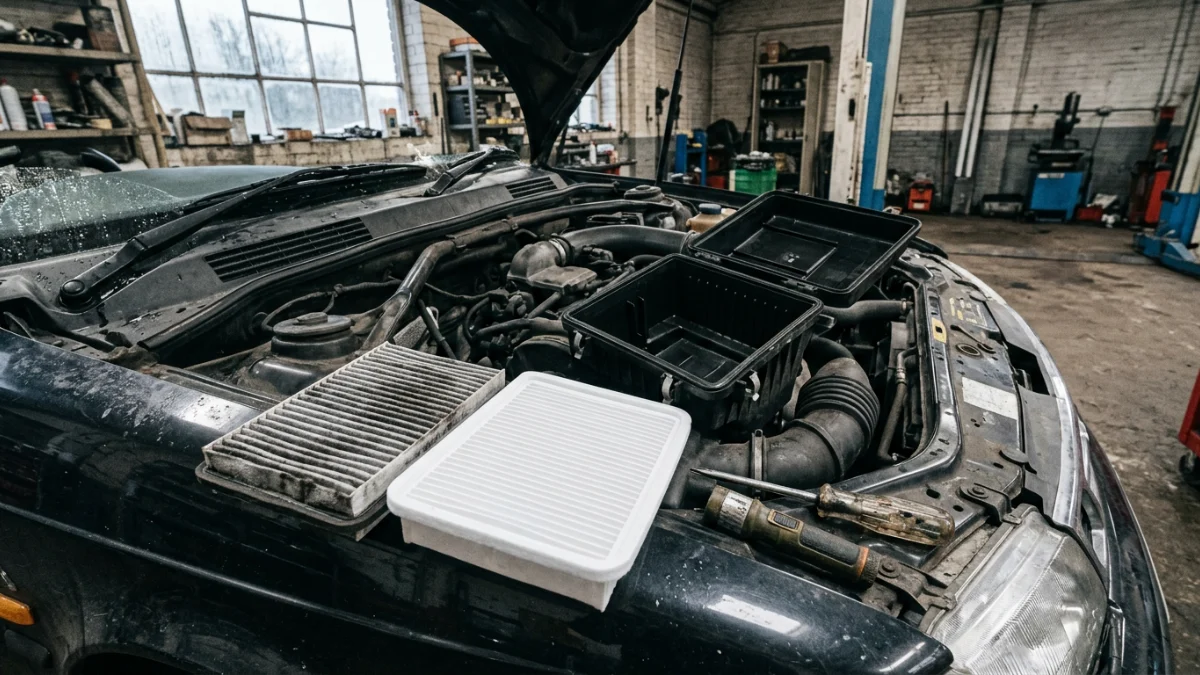
A major service adds the long interval items: the fuel filter, the spark plugs on a petrol engine, the cabin filter, and tests on brake fluid and coolant condition, with renewal where the schedule calls for it. The full service list stays.
Four earn their place going into winter. A diesel fuel filter holds the water it has collected and restricts flow once full. Worn plugs widen the gap the coil has to bridge, which shows on a cold start. Brake fluid absorbs moisture, lowering its boiling point. A blocked cabin filter chokes the blower.
The checks below run across the three levels, and each tells the technician something.
| Check | What the reading tells the technician | Lowest level it appears in |
|---|---|---|
| Tread depth measured | How close the tyre sits to the DVSA legal minimum of 1.6mm across the central three quarters | Interim |
| Brake pads and discs measured | The friction material left, and whether the disc is near its wear limit | Full |
| Battery drop test | The cranking voltage held under load, which is what a frosty morning asks of it | Full |
| Coolant strength tested | The temperature the mix protects to, and whether water topping up has weakened it | Full |
| Auxiliary belt and tensioner inspected | Whether cracking or a noisy tensioner threatens the alternator and water pump drive | Full |
| Suspension and steering checked | Whether a split gaiter or worn joint is heading for an MOT advisory | Full |
| Brake fluid tested | How much moisture the fluid has absorbed | Major |
The three levels read more clearly side by side.
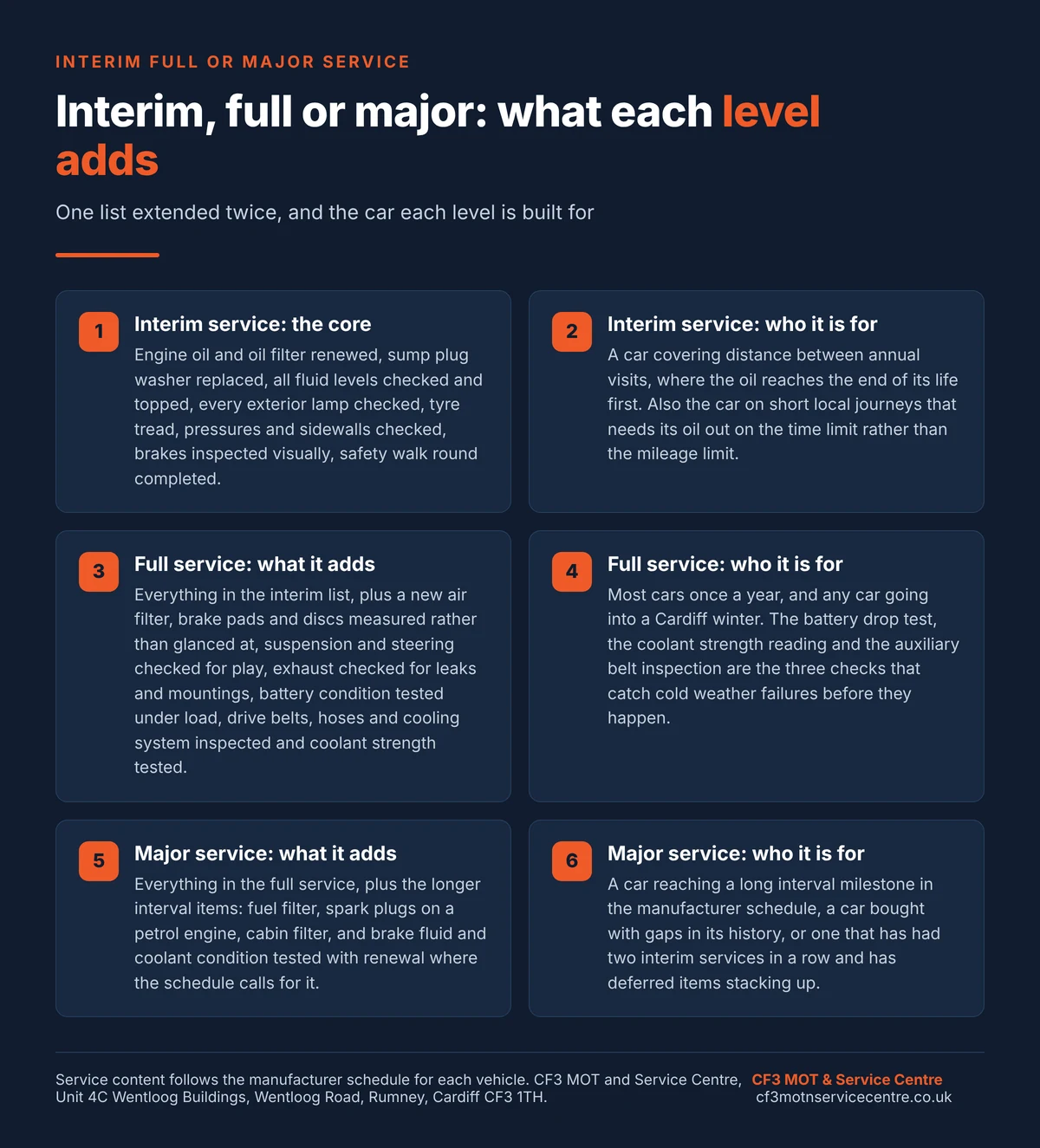
- Interim. Oil and filter, fluid levels, lights, tyres, visual brake check, safety walk round. For a car covering distance between visits.
- Full. Adds air filter, measured brakes, suspension and steering, exhaust, battery condition, belts, hoses, cooling. For most cars yearly, and any car facing winter.
- Major. Adds fuel filter, spark plugs on petrol, cabin filter, brake fluid and coolant condition. For a car at a long interval.
How to choose the service your car is due
The level your car is due is settled by five things: time since the last oil change, distance covered, how the car is driven, what the last sheet left undone, and the schedule and any MOT advisory.
Choose by time, not only by mileage
Manufacturer schedules carry a distance limit and a time limit, and whichever arrives first governs. Oil degrades by time as well as distance, so a car on short local journeys reaches the time limit well before the mileage. Our guide to how often to service a car in Cardiff covers both.
Choose by what the last service sheet lists
Read the last sheet item by item rather than the heading at the top. Two interim services in a row mean the air filter, the brake measurements and the cooling checks have been deferred twice, and those items are the argument for a full service. The list behind each level sits with interim, full and major service prices.
Choose by the schedule and any MOT advisory
Your handbook names the level, and some cars run a variable schedule where the indicator counts oil condition rather than miles. An advisory for pad wear, a weeping damper or a corroded brake pipe is a reason to step up, because the item is then measured and quoted. See the pre-MOT checks page.
Have the schedule read for your own car first
Give CF3 the registration, the last service date and the mileage now, and the workshop in Rumney will say which level the schedule calls for and what was left undone.
Why short cold journeys around east Cardiff change the interval
Short journeys never let the oil reach operating temperature, so moisture and unburned fuel stay in the sump instead of evaporating off. The oil thins, its additive package is used early, and the time limit matters more than the mileage.
A cold engine runs a richer mixture, and some of that fuel passes the piston rings into the oil. Combustion produces water vapour, and a cold crankcase condenses it. A long run at full temperature boils both off. A short hop does not.
That pattern describes a great deal of driving in east Cardiff: a school run from Rumney to Llanrumney, a trip to the shops at St Mellons, a crawl along Newport Road. All of it adds cold starts without adding distance, so the oil comes out on time whatever the miles say.
Why a service before the cold weather beats a recovery during it
Winter finds the weak parts first. A battery that coped all summer gives up on the first frosty morning, a tired auxiliary belt lets go, and a weak coolant mix leaves no margin below freezing. All three sit in the full service list.
Cold multiplies the demand. A cold engine is stiffer to turn and a cold battery delivers less current, so the cranking voltage on a drop test is the most useful reading in November. Our guide to winter car checks covers the walk round, and a car that will not start on a cold morning reports what the test would have shown weeks earlier.
The rest comes off the same list. Screenwash concentrate at the right strength keeps the jets from freezing. Tread depth and sidewall condition decide whether the car stops in standing water on the A48. CF3 fits car batteries at the Rumney workshop, so a failed drop test is settled that day.
A service taken before the cold is a planned appointment. The same three faults in January are a roadside call out and a car off the road.
What a service is not, and what it will not fix
A service is not an MOT, and it does not repair a fault the car already has. The MOT test records whether the vehicle meets a legal standard on the day, and a service replaces consumables and reports condition.
No part of a service carries legal weight: no certificate, no change to the test due date, no guaranteed pass. It corrects avoidable failures rather than writing them down.
A service also stops where diagnosis begins. A stored fault code, a misfire, a knocking noise or a dragging brake needs its own time on the ramp, and an engine diagnostics session is booked separately.
Belt replacement is the other exclusion. Cambelt replacement, and wet belt replacement on the engines that use one, run on their own interval and form no part of a service at any level.
What the oil grade and the filter decide
An oil change is only as good as the grade going in and the filter going on. The grade sets how the oil flows cold and holds its film hot. The filter keeps the debris it collects out of the engine.
What the grade on the oil cap means
A grade is written as a number, the letter W for winter, then a second number. The first describes how readily the oil flows cold, the second its viscosity once hot. A grade too thick cold starves the top of the engine on a frosty start, and one too thin hot leaves the bearings without their film. The manufacturer specification matters as much, because a low ash oil protects a diesel particulate filter. Both come off the handbook.
Why the filter matters as much as the oil
The filter holds the soot, carbon and wear metal the oil has carried. A filter left in place fills, and once full the bypass valve opens so unfiltered oil circulates. A reused sump plug washer weeps. Filter, washer and the right refill quantity separate an oil change from a top up.
What goes on the job sheet, and what the record is worth later
Every reading goes on the job sheet beside the item it belongs to, so the pad thickness, the cranking voltage and the coolant strength are written down rather than described. CF3 tests before it quotes.
A service history is what a buyer looks for when the car is sold. A stamped book with dated invoices showing the level carried out, the mileage and the items renewed proves the schedule was followed. A gap leaves a buyer guessing. CF3 stamps the book and keeps the record against the vehicle, so the next visit starts from what the last one measured.
CF3 MOT and Service Centre is a DVSA approved test station and an all makes garage at Unit 4C Wentloog Buildings, Wentloog Road, Rumney, Cardiff CF3 1TH, five minutes off the A48. Cars, vans, fleet vehicles and motorhomes go through the workshop. Evening and Saturday appointments are available.
Interim, full and major service questions
Which service does a car doing only short local journeys need?
A car doing only short local journeys needs its oil changed on the time limit rather than the mileage limit. Short runs leave moisture and unburned fuel in the oil, because the engine never gets hot enough to boil either off. An interim service on time, plus a yearly full service, fits.
Is a full service every year enough?
A full service once a year is enough for most cars, provided the long interval items are picked up when they fall due. Spark plugs, the fuel filter, the cabin filter and brake fluid run on their own schedule, and a major service catches them. Check the handbook.
Does a major service include the cambelt?
A major service does not include the cambelt. Belt replacement is a separate job with its own mileage and time interval, and the work involves removing covers, mountings and tensioners. A quote bundling a cambelt into a major service is two jobs under one name.
Will a service clear a warning light?
A service does not clear a warning light, and clearing one is the wrong first move. A light means a fault code is stored, and the code needs reading before anything is reset, because a cleared code takes the evidence with it. Book diagnostics alongside the service.
Can an MOT and a service be done in the same visit?
An MOT and a service can be done in the same visit, and the service is best done first so wear items are corrected before the tester inspects the car. Our page on booking the test and the service together sets out the sequence.
Does a service guarantee the car will not break down?
A service does not guarantee the car will not break down. It renews consumables on schedule and reports condition, which removes the failures caused by neglect and deferred items. A component can still fail without notice. A service turns most winter failures into something measured in advance.
Choosing the service level on evidence
The three levels are one list with two extensions, so the question is never which service is best. It is which level the car has reached, and that comes from the time since the last oil change, what the last sheet left undone, the handbook and the last test.
Ring CF3 MOT and Service Centre on 07400 454839 with your registration, or bring the car to the Rumney workshop at Unit 4C Wentloog Buildings, Wentloog Road, Cardiff CF3 1TH. The garage reads the schedule, measures before it quotes, and writes the reading beside the price on the sheet.
Book the level your car is actually due
Ring CF3 MOT and Service Centre in Rumney on 07400 454839 with your registration, or book through the widget above. The workshop confirms which level the schedule calls for and what it measured before any extra work is agreed.

