
Book Online
07400454839
-
By: Ali Hindal
- 0 Comments
A car that will not start is diagnosed from what it does when the key is turned, because that one observation separates a flat battery from a failed starter, a fuel fault or a locked immobiliser.
The first hard frost of a Cardiff winter fills a workshop with cars that turned over without complaint in October. Most owners arrive having already bought a part. A battery goes on a car with a corroded earth strap, or a starter goes on a car whose battery collapsed under load.
This page sets out the order a technician works in. It begins with what your car does when you turn the key, the one thing you can observe from the driver’s seat, and ends with the tests that name the failed part. CF3 tests before it quotes, and the reading goes on the job sheet next to the price.
Why a car will not start, in order of what to check
- Seven behaviours split the fault: no lights, one click, rapid clicking, slow crank, normal crank, a start that dies, or no crank with a key symbol.
- One single click points at the starter or its feed. Rapid clicking points at a battery that cannot hold voltage as the solenoid pulls in.
- A slow crank is a current problem. A normal crank with no catch moves the question to fuel, spark, compression or a sensor.
- Resting voltage is the weakest test. Cranking voltage and a drop test decide the job, and a battery can read as charged at rest and fail both.
- Corroded terminals and earth straps give the symptoms of a dead battery, and both are found by hand first.
- Cold thickens oil and cuts the current a battery delivers, so a battery weakened over the summer is found in December.
- A jump start that works proves the starter and engine are capable, leaving the battery and charging system.
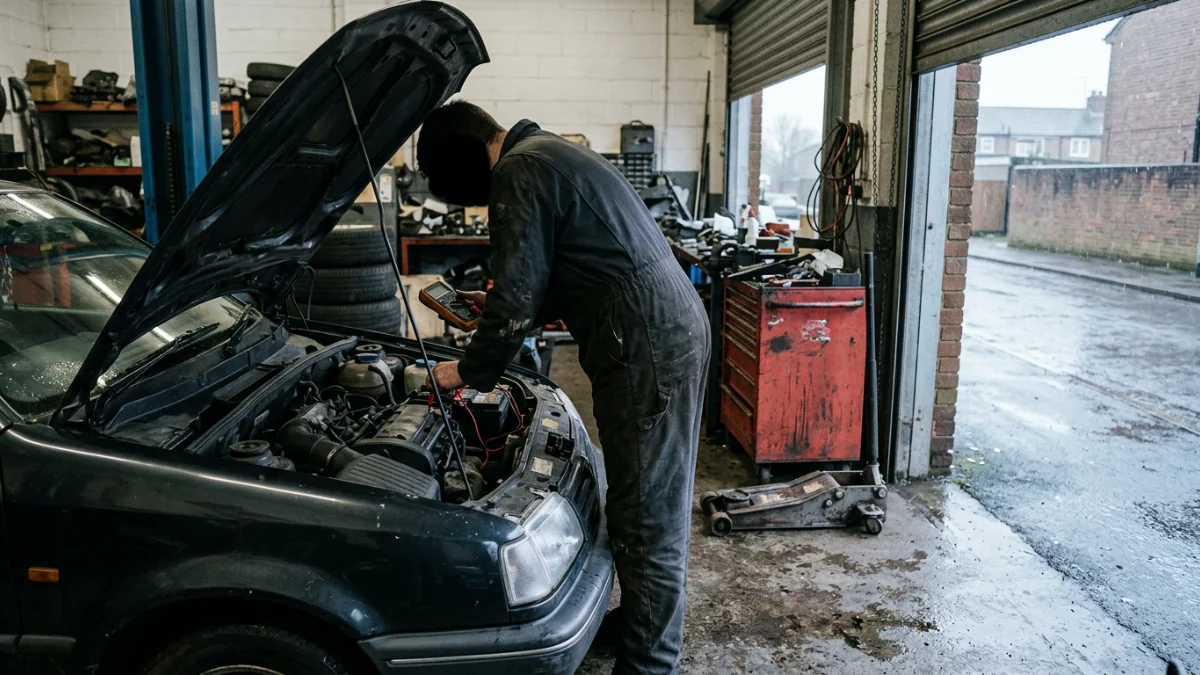
What the car does when you turn the key is the branch point
What the car does when you turn the key narrows the fault to one small group of parts before a tool comes out. A starter that does nothing, one that clicks and one that spins the engine freely are three separate jobs.
Describe the behaviour rather than your conclusion when you ring a garage. An owner who says the engine turns over but will not fire has ruled out the battery and the starter in one sentence. The table sets out all seven.
| What the car does | What it points at | Tested next |
|---|---|---|
| Nothing, no lights, no click | Dead or disconnected battery, loose terminal, failed earth, blown fuse | Battery voltage, terminals, earths, fuses |
| Dash lights on, one single click | Solenoid pulling in, motor still, failed starter, seized engine | Cranking voltage, the feed, the starter |
| Dash lights on, rapid clicking | A battery collapsing as the solenoid pulls in, or a bad connection | Drop test, terminals and earths |
| Cranks slowly, will not catch | Too little current, or more drag than the starter can turn | Cranking voltage, drop test, oil grade |
| Cranks normally, will not catch | Fuel, spark, compression or a sensor the engine needs to fire | Fault codes, fuel, glow plugs, crank sensor |
| Starts and dies immediately | Fuel delivery, idle control, or the immobiliser cutting the engine | Fault codes, fuel delivery, immobiliser |
| No crank, key symbol lit | The key is not recognised, a flat key battery, or low system voltage | Key battery, stored codes, cranking voltage |
The three electrical branches: nothing, one click, rapid clicking
All three behaviours sit on the supply side, between the battery and the starter. None is a fuel fault, and the first checks are voltage and connection, not a diagnostic socket.
Nothing at all, no lights and no click
A car that gives no dash lights and no click has lost its supply rather than its ability to turn. The battery is flat beyond the point of lighting a dashboard, a terminal clamp has gone loose or green, an earth strap has corroded through, or a main fuse has blown. A car that is completely dark, with no central locking and no interior light, points at the battery or its feed, and a jump pack settles that in a minute.
Dash lights on and one single click
One single click with a bright dashboard means the solenoid pulled in and the motor did not turn. Silence after that click means the motor is not receiving current, or the engine will not move.
Three findings sit behind the click: worn brushes or a failed winding inside the starter, a corroded or loose feed at the starter terminal, or an engine that cannot turn from hydrolock or a seized auxiliary. Turning the engine by hand at the crank pulley separates the last from the first two.
Dash lights on and rapid clicking
Rapid clicking is the sound of a battery that cannot support the solenoid. The solenoid pulls in, voltage collapses, the solenoid drops out, voltage recovers, and the cycle repeats several times a second. The battery, not the starter, is the suspect.
A restricted connection makes the identical noise, because a corroded clamp or a loose earth limits current just as a tired battery does. Terminals and earths are cleaned and checked before a battery is quoted, since a new battery on a car with a corroded earth strap gives the same fault a fortnight later.
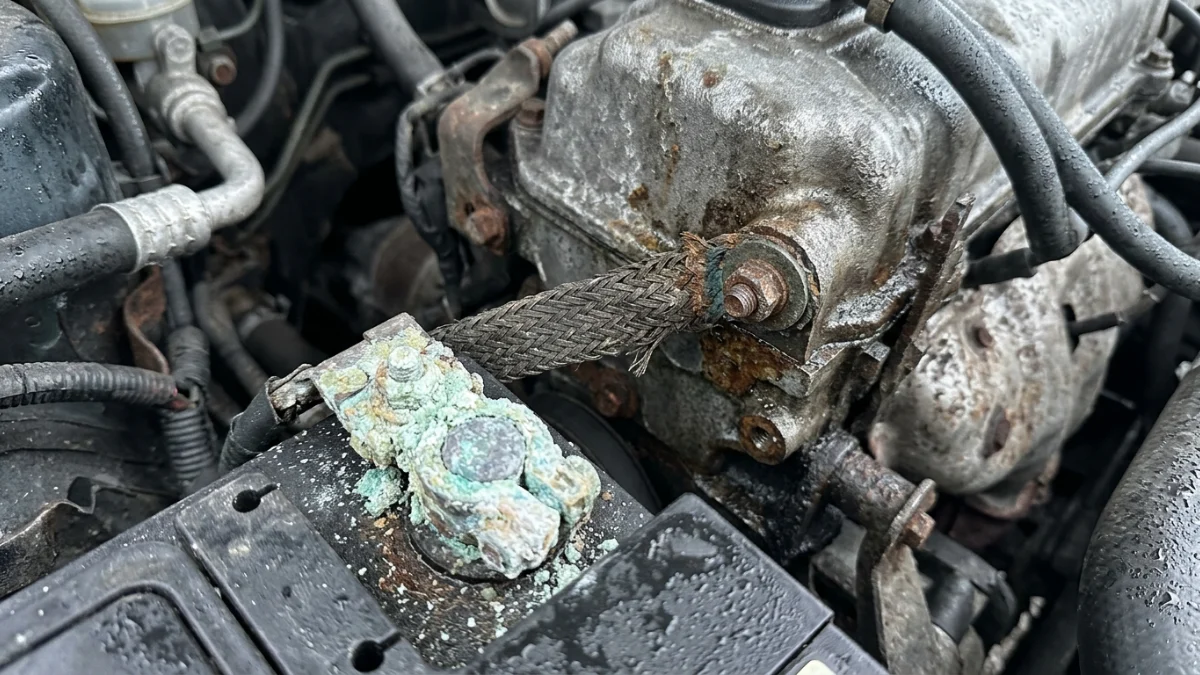
A car that will not turn over on your drive is worth a phone call before a parts order. Describe what it does when you turn the key and the workshop can say whether that is a jump pack or a recovery truck. CF3 is on Wentloog Road in Rumney, off the A48.
Cranking but not catching: slow crank against normal crank
Once the engine is turning, the battery and the starter have proved themselves in some measure, and the speed of that turning decides where the search goes next.
The engine cranks slowly and will not catch
A slow crank means the starter is turning the engine below the speed it needs in order to fire. Either the current reaching the starter is too low, or the resistance it must overcome is too high. Cold pushes both at once.
A tired battery, a corroded connection and a worn starter all reduce cranking speed. Thick or degraded oil, the wrong winter oil grade and a dragging accessory add load. A diesel with a weak battery and oil past its interval cranks slowly on a frosty morning and catches on a mild one, so the fault seems to come and go.
The engine cranks normally and will not catch
An engine that cranks at normal speed and does not fire has a fuelling, ignition, compression or signal fault, and the battery and starter are cleared. The engine turns properly without producing combustion, so the search moves to what is missing at the moment of firing.
The order is fixed. Stored fault codes come first, because a failed crankshaft or camshaft sensor usually leaves a record. Fuel comes next, from the level in the tank to the pump priming on ignition. Glow plugs follow on a diesel, and compression is last. An engine diagnostics check establishes which of the four is missing rather than replacing parts in hope.
The engine starts and dies within a second or two
An engine that fires and then stops has proved its starter, its battery and its compression, and lost either fuel or permission to run. The fault sits in fuel delivery, in idle control, or in an immobiliser that allows the start and then cuts it.
Fuel delivery is the common finding. A pump that primes and loses pressure, a blocked filter, water in the fuel after weeks parked, or the wrong fuel in the tank will all let an engine fire on what is in the rail and then stall.
An immobiliser fault gives itself away by the pattern. The engine runs for a second or two and cuts cleanly, often with a key symbol flashing, because the module allowed the start and then withdrew the fuelling. A rough idle that dies more slowly is an air, sensor or engine management fault, and the stored codes separate the two.
No crank at all with the immobiliser or key symbol lit
A car that will not crank with a key or immobiliser symbol lit is refusing to start rather than failing to start. The security system has not recognised the key, so the starter is never energised and the fuelling never enabled.
Three findings cover most of these cars. A flat battery in the key fob, which is why holding the fob against the start button often works on a keyless car. A failed ring antenna at the ignition switch. A low vehicle battery, because a module that browns out during cranking withdraws the authorisation while the dashboard looks normal.
Voltage is checked before the security system is blamed, because a warning light that appears alongside a slow crank is usually the battery. Our guide to engine management light causes covers the lights that arrive with a no start. The seven branches are easier to hold as one picture.
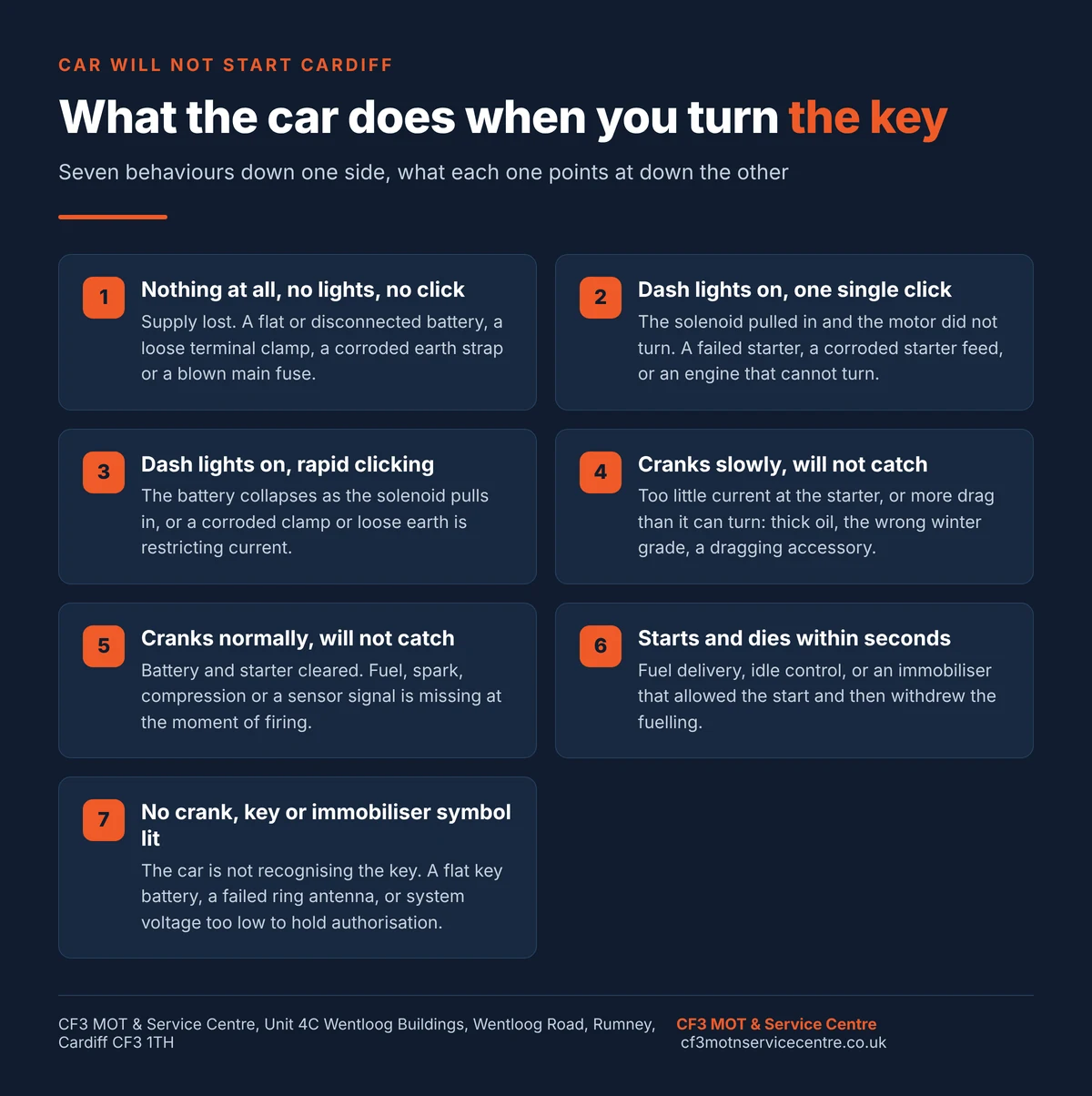
- No lights, no click: battery, terminal, earth or fuse.
- One single click: starter, feed or seized engine.
- Rapid clicking: collapsing battery or bad connection.
- Slow crank: low current, thick oil, drag.
- Normal crank: fuel, spark, compression, sensor.
- Starts then dies: fuel, idle control, immobiliser.
- No crank, key symbol: key, key battery, voltage.
The tests in the order a technician runs them
The tests run cheapest and fastest first, and each one either clears a part or condemns it.
- Battery voltage at rest. Taken with everything switched off. It finds a discharged battery or a dead cell, and clears nothing.
- Cranking voltage under load. Watched while the starter turns the engine. A battery that holds voltage is doing its job, and one that falls away is the fault whatever it read at rest.
- The drop test. Load is applied deliberately, through a carbon pile or an electronic tester, and the battery is watched for the length of the test.
- Terminals, clamps and earth straps. Posts and clamps are cleaned, and the engine and body earth straps are checked for corrosion and tightness. A restricted earth gives a slow crank or no crank.
- The starter and its feed. Voltage at the starter terminal during cranking separates a starter that is not fed from one that is fed and will not turn.
- The alternator and charging output. Measured with the engine running and load applied. It answers whether the battery went flat because it was never charged.
- Whether the battery was flat before it was charged. A deeply discharged battery is not the battery it was, so the drop test is repeated after charging.
- Glow plugs on a diesel from cold. Each plug is tested for resistance and current draw, because a diesel with two dead glow plugs starts in September and not in a Cardiff December.
- Fuel, then the immobiliser. Fuel level, pump prime, filter condition and water in the fuel on a car that cranks and will not fire. The key battery and stored codes are last.
The two steps owners buying their own parts skip are the two that settle most of these jobs.
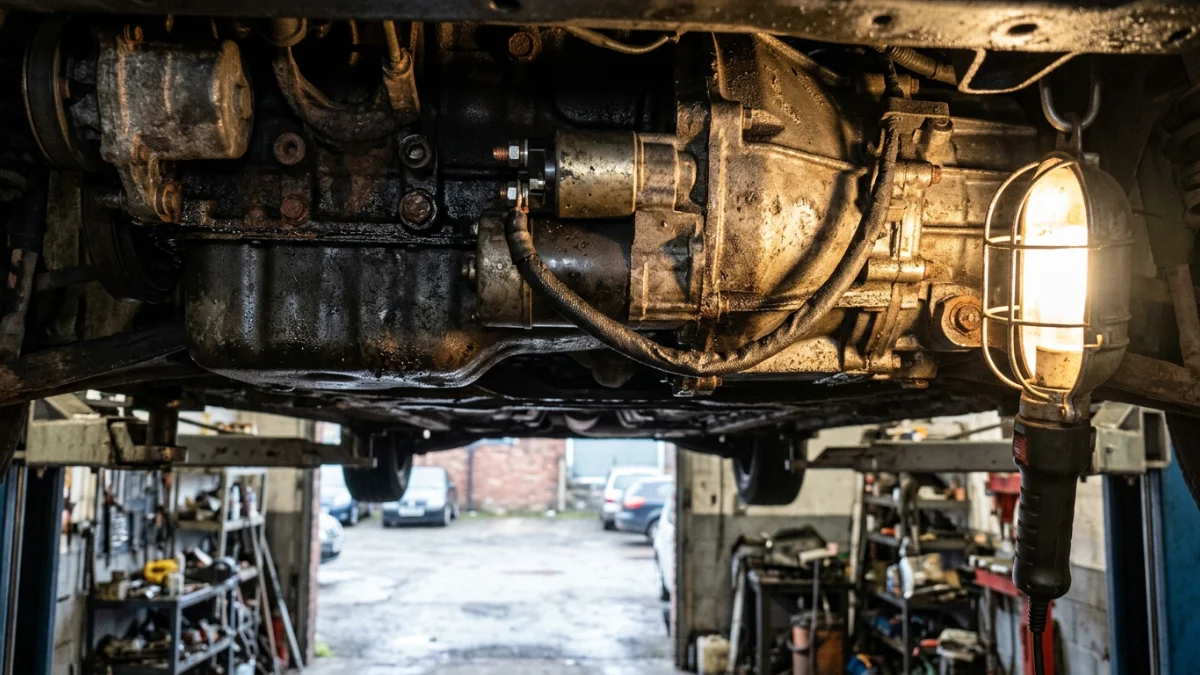
Why a battery that reads fine at rest fails under load, and what a jump start proves
A battery reads fine at rest and fails under load because resting voltage reports surface charge while cranking draws hundreds of amps from the plates. A battery with sulphated plates or a lost cell holds a respectable resting reading, then collapses the moment the starter asks for current.
A successful jump start carries a specific message. It proves the starter turns, the engine is free, the immobiliser is satisfied and the engine runs, which leaves the battery that could not do it alone and the alternator that should have kept it charged. A car that starts unaided the next morning is holding charge, so the fault is drain or charging. One that does not has lost capacity, and a tested replacement battery is the answer rather than another jump.
Have the cranking reading taken before you buy a battery
A drop test and a cranking reading settle whether the battery, the earths or the starter is at fault, and the figures go on your job sheet. Battery delivery and fitting covers east Cardiff if the car will not move.
Why a Cardiff winter finds the battery that was already weak
A Cardiff winter rarely breaks a healthy battery. It exposes one that had already lost capacity over the summer. Cold thickens engine oil, so the starter has more drag to overcome and draws more current to turn the engine at the same speed, while the battery delivers less current cold than warm. More demand and less supply meet on the same morning, and a battery that was marginal in August fails in December.
Journey length does the rest. Short damp runs across Rumney, down Wentloog Road and along the A48 never put back what starting the car takes out, with the blower, the heated rear screen, the lights and the wipers all drawing at once. A car used for school runs loses ground daily.
Condensation finishes the picture. Damp air under a bonnet condenses on cold metal, and that moisture sits on posts, clamps and earth points where it drives corrosion. A green crust on a terminal and a white bloom on an earth bolt both restrict current, and a winter car check finds them first.
What not to do, and how to jump start safely
Three actions turn a cheap job into an expensive one. Do not keep cranking. Do not bump start an automatic. Do not drive away from a jump start and park the car up again.
Continuous cranking overheats the starter and its solenoid, drains what is left in the battery, and on an engine that fuels without firing it washes the bores and passes unburnt fuel into the exhaust. Crank in short attempts and let the starter cool between them.
Bump starting works only on a manual gearbox. An automatic uses a torque converter and a pump driven by the engine, so pushing the car does not turn the engine, and towing an automatic to start it risks the transmission.
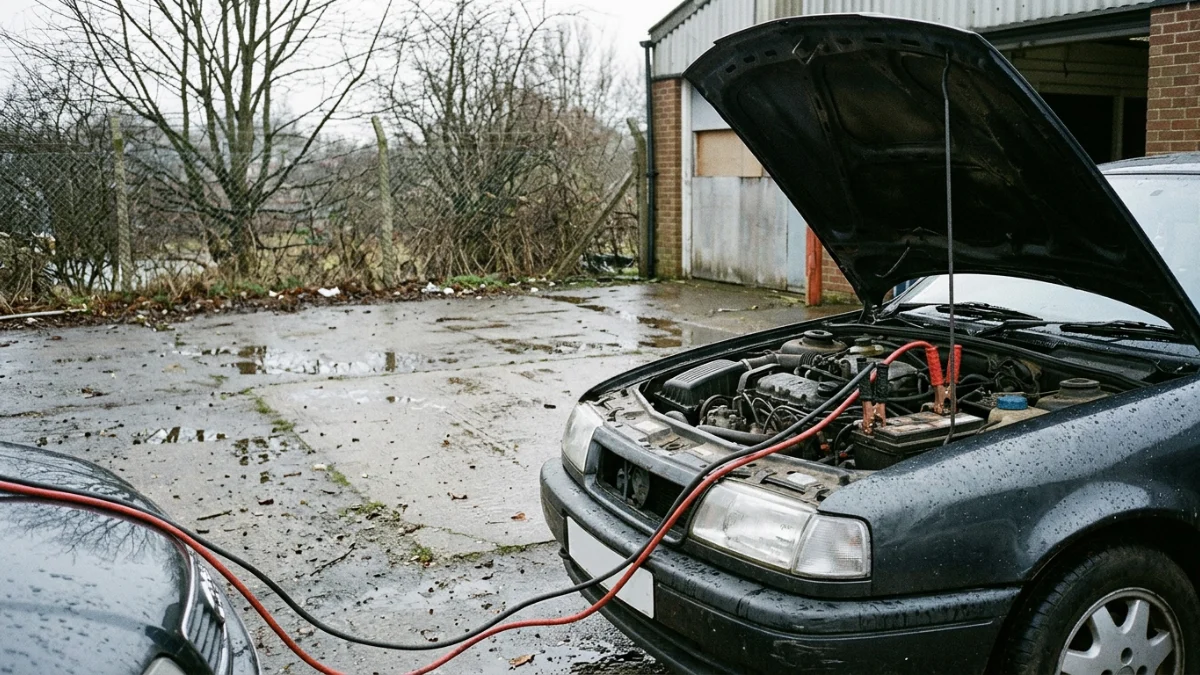
Jump starting safely follows a fixed order. Both engines off. Red lead to the positive post of the flat battery, then to the positive post of the donor. Black lead to the negative post of the donor, then to a solid earth point on the flat car. Start the donor, let it run, then start the flat car, and remove the leads in reverse order.
A battery brought back by a jump start then needs a proper charge, from a long continuous drive or a mains charger, because alternator output on a short winter run will not refill it.
How CF3 works a car that will not start in Rumney
CF3 MOT and Service Centre works a no start in the order set out above, from the battery readings outward, and quotes a part only once a reading has condemned it. Ali, the owner and lead technician, does the testing and signs off the job.
The route in depends on whether the car moves. One that starts on a jump pack is driven to the Wentloog Road workshop, and the drop test and charging check are done on arrival. One that will not move comes in on vehicle recovery, or is collected where the diary allows.
What you get back is the reading and the reason: cranking voltage, the drop test result, the state of terminals and earths, and charging output. A starter motor that genuinely needs replacing is replaced, as the Renault Twingo starter motor job shows. Mention any noise that arrives with a hard start, because a knock heard while the engine cranks is a separate matter, as our guide to engine knocking noises explains.
CF3 is a DVSA approved test station and an all makes garage at Unit 4C Wentloog Buildings, Wentloog Road, Rumney, Cardiff CF3 1TH, minutes from St Mellons, Llanrumney and the A48. Cars, vans, fleet and motorhomes go through the workshop, and evening and Saturday appointments are available.
Car will not start questions
Why does my car start after a jump but not the next morning?
A car that starts on a jump and not the next morning has lost battery capacity, or has a drain or a charging fault. The jump supplied current the battery could not. A drop test after charging, a charging output reading and a drain check separate the three.
Is it the battery or the starter motor?
The sound decides it. Rapid clicking, dim lights and a slow crank point at the battery or its connections. One single click with a bright dashboard points at the starter motor or its feed. Voltage at the starter terminal while the key is turned confirms which.
Can a flat battery cause warning lights and strange faults?
A failing battery causes warning lights, stored fault codes, window and locking faults and immobiliser messages. Modules brown out when system voltage falls during cranking and log faults unrelated to the parts named in the codes. Voltage is corrected before those codes are investigated.
Why will my diesel not start cold but start fine later?
A diesel that starts warm and not cold usually has failed glow plugs, a weak battery, or both. Glow plugs heat the combustion chamber so the compressed air reaches the temperature diesel needs. With one or more dead, a cold engine will not fire.
Does the MOT test the battery or the starter motor?
The MOT does not test battery capacity or the starter motor. Battery security and visible wiring are inspected, and a battery that is loose or leaking is a defect. Cranking voltage and charging output sit outside the test, so a car can pass and still not start.
Should I keep turning the key if the engine will not fire?
Continuous cranking does damage and should be avoided. The starter overheats, the battery is drained, and unburnt fuel passes into the exhaust on an engine that fuels without firing. Short attempts with pauses are safe, and several failures mean the car needs testing.
Getting the engine turning again
A car that will not start has one of seven behaviours and a short list of parts behind each, so the fault is found by observation and measurement rather than by replacing the cheapest suspect. Tell the garage what the car does when you turn the key, and most of the diagnosis is done.
Book the car into the garage in Rumney on 07400 454839 with your registration, or ask for recovery if it will not move. CF3 MOT and Service Centre is at Unit 4C Wentloog Buildings, Wentloog Road, Rumney, Cardiff CF3 1TH, and the readings go on the job sheet next to the price before any part is fitted.
Find out why it will not start before you buy the part
Ring CF3 MOT and Service Centre in Rumney on 07400 454839 with your registration and a description of what the car does when you turn the key. The battery, the earths, the starter and the charging output are tested first, and the figures come back with the price.

