
Book Online
07400454839
-
By: Ali Hindal
- 0 Comments
A winter car check takes ten minutes on your own drive and covers ten things in order: the battery, the tyres, the brakes, the lights, the wipers and washers, the screen and demister, the coolant, the oil, the underside and what you carry.
Cardiff winters rarely break a car in one night. They find what was already marginal. A battery that was slow in October, tread that was legal in the dry, a wiper that smeared, a bulb nobody noticed in daylight.
Each check below has what to look for, what good looks like and what to do when it is not. The last section separates the ones you can finish on a drive from the four that need a ramp.
The ten minute winter check, at a glance
- Work round the car in one direction, cold, before the first drive.
- A cold crank tells you more about the battery than any afternoon start does.
- The legal minimum tread depth is 1.6mm across the central three quarters of the tread, which is a DVSA requirement.
- Pressures are set cold, because a warm tyre reads high.
- A rust film on the discs after a salted night clears in the first few stops. A noise that stays is a fault.
- Screenwash mixed for summer freezes in the reservoir, the pipe and the jets.
- Misting inside is usually a blocked cabin filter, recirculation or a wet footwell.
- Six of the ten need only daylight. Four need a ramp, a meter or a tester.
What the walk round covers, and the order to do it in
The walk round goes in one direction so nothing is missed. Start at the driver’s door with a cold engine, turn the key and listen. Work round at wheel level for tyres and brakes, again at eye level for lights and glass, then under the bonnet and down at each sill.
Do it cold, because a cold battery, cold tyres and a cold engine are the condition every winter fault shows in. Do it in daylight, because a misted lens and a bubbled sill hide under a street lamp.
The result is a list rather than a verdict. Anything on it touching grip, stopping or visibility belongs in a workshop the same week, and CF3 runs the same sequence as a paid car safety check with the car on a ramp. The battery comes first.

- Battery: how fast and evenly it turns from cold.
- Tyres: tread across the whole width, sidewalls and cold pressures.
- Brakes: whether the first stop noise goes by the end of the street.
- Lights: every lamp, fog and number plate lamps included.
- Wipers and washers: a clean sweep, and jets reaching the glass.
- Screen and demister: clearing time, and any wet footwell.
- Coolant: at the mark and at strength, not topped up with water.
- Oil: level and grade checked cold.
- Underside: bubbling along the sills and arches.
- Boot: scraper, torch, screenwash, inflator and jump pack.
Get the one that worries you measured this week
Ring CF3 MOT and Service Centre in Rumney and say what you found, whether that is a slow crank, a noise under braking or tread down on one shoulder. The car goes on the ramp and you get the reading before a price is agreed.
Check one: the battery and the cold crank
A battery heading for failure gives notice on a cold morning. Cold cuts what it can deliver while thick oil increases what the starter needs, so the margin that hid the fault in summer has gone.
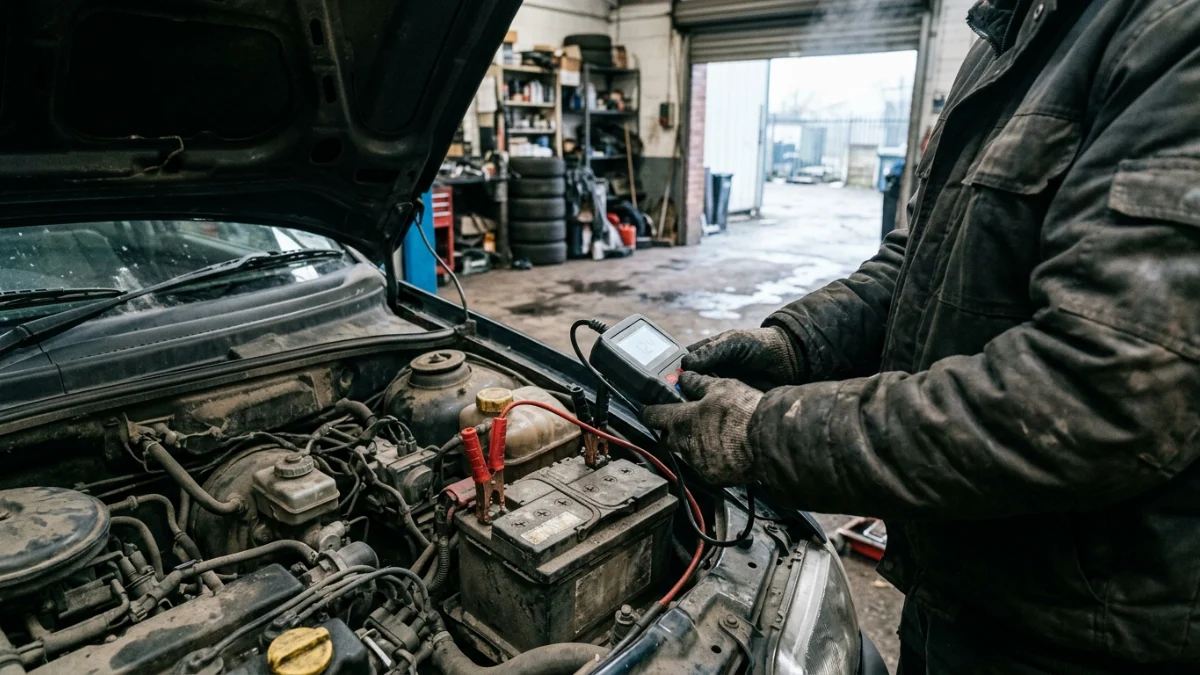
- Look for crank speed and evenness, dash lights dimming as the starter turns, a click with no crank, crust on a terminal.
- Good looks like an engine that turns quickly and fires in a second or two, with the same starter note as last week.
- Not good is slow cranking, a jump start, or a flat battery after a weekend standing. Have the resting voltage read and a drop test done under load, because an alternator fault, a parasitic drain and a dead cell feel the same from the driver’s seat.
Battery condition is a measurement, so battery testing and fitting starts with that reading rather than the age on the label. A car that will not turn over at all follows the sequence in our guide to a car that will not start in Cardiff. Once it starts, grip is next.
Check two: tread across the whole width, sidewalls and pressures
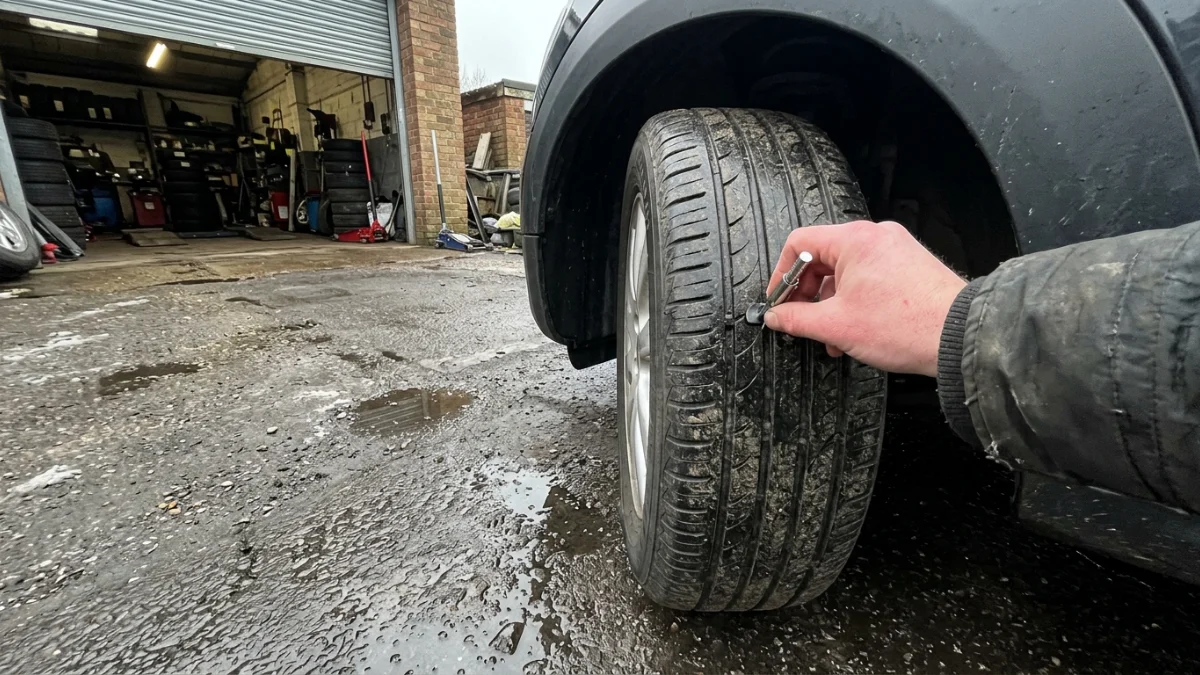
Tread does its real work in standing water. Rain pooling on the A48 and on Newport Road goes somewhere, and the only route is through the grooves in your tyres. The legal minimum is 1.6mm across the central three quarters of the tread, which is a DVSA requirement.
Measure the inner edge, the middle and the outer edge of each tyre, because a pressure or alignment fault takes one edge first and leaves the centre looking healthy. Steer to full lock to see each inner sidewall, and set pressures cold to the door pillar figure.
- Look for readings at three points per tyre, wear heavier on one edge, cuts and bulges on both sidewalls.
- Good looks like even depth across the width, clear of the legal minimum, clean sidewalls, pressures close to the plate figure.
- Not good is any reading at or below 1.6mm, wear at the indicator bars, a bulge or cut showing cord, or a tyre that will not hold pressure for a week. A bulge is a tyre off the car, not a top up.
Uneven wear is an alignment question as well as a tyre one, because a new tyre on a car out of alignment wears the same way. Tyre supply and fitting is better sorted before the first hard frost than after it. Grip gets you round a wet corner. The next check stops the car.
Check three: brakes after a wet, salted night
Discs that stand overnight in wet, salted air grow a light film of surface rust by morning. Telling that apart from a fault on your own drive is straightforward, because the difference is whether the symptom clears.
Rust rumble on the first pull
A dry scraping on the first turn of the wheels, gone by the end of the street, is rust being wiped off the disc faces by the pads. Salt and overnight damp speed that film up, so it happens far more in December than in July.
A symptom that stays, which is a fault
A squeal at every stop once the car is warm, grinding you feel through the pedal, a pull to one side under braking, a wheel hotter than its opposite number, or a handbrake that will not hold on a Rumney hill. A caliper that has stood wet and salty can seize on its slide pins, and a binding caliper drags the pad and heats the hub.
A driveway brake check is a listening check, so anything that stays belongs on a ramp where pad and disc thickness get measured. The noises are separated in our guide to squealing, grinding and spongy brakes, and brake repairs and replacement covers the work. Once the car stops properly, the question is whether other drivers can see you.
Check four: every light, including the two nobody checks
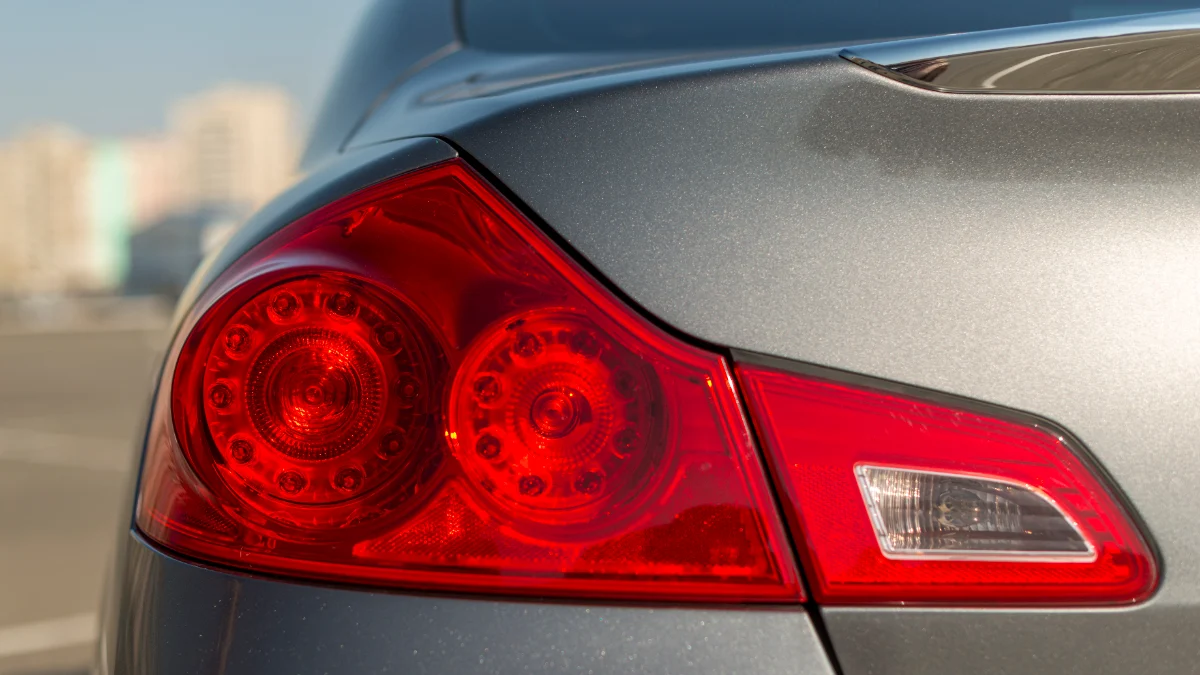
Dark afternoons keep your lights on for most of your driving, so a bulb that was minor in June now matters. Work through the lot with the ignition on, rear fog lamp and number plate lamp included. Those two fail MOTs because nobody looks at them.
- Look for every lamp lit at both ends, correct colours, no cracked lenses, no water inside a unit.
- Good looks like a full set working, clear lenses, and a dipped beam level against a garage door rather than up into hedges.
- Not good is a dead lamp, a lens with water in it, or a beam aimed high enough to dazzle. Condensation inside a headlamp means a failed seal, and standing water corrodes the holder and the connector.
Every item here is in the test, as our page on what an MOT actually checks sets out. Lights let you be seen, and seeing out is the next pair of checks.
Check five: wipers, washers and screenwash concentration
Winter glare is what exposes a tired wiper. Low sun through a screen that is smeared or pitted by grit throws light across your whole field of view, and cold spreads a chip in the swept area into a crack. Screenwash mixed for summer freezes in the bottle and the jets, which leaves you no way to clear salt spray off the A48.
- Look for a torn or hardened blade edge, chatter, bands on the return sweep, jets reaching the upper third of the screen.
- Good looks like a clean full sweep with no streaks, both jets hitting the glass, and the rear wiper working too.
- Not good is a smearing blade, a blocked jet, or a reservoir of plain water. Mix to the concentrate instructions for winter, then run the jets until the new mix is through.
Clearing the outside of the screen solves half the visibility problem. The other half comes from inside the car.
Check six: why the car mists up inside
The inside of a car mists because warm damp air meets cold glass. Wet coats, wet mats and your own breath supply the water, and winter glass is cold enough to condense it within minutes. The cause is how much water is in the cabin and how much air the blower moves at the screen.
- Look for how long the screen takes to clear on full blower, weak airflow at the vents, damp carpet under the mats.
- Good looks like strong airflow, glass clearing from the edges in a minute or two, dry carpet, real heat once warm.
- Not good is weak airflow or carpet wet to the touch. A blocked cabin filter chokes the air at the screen, recirculation sends the same damp air round, and a blocked scuttle drain keeps the cabin wet.
Change the cabin filter and clear the scuttle drains. Heat and demisting both depend on what is in the cooling system.
Checks seven and eight: coolant strength and oil
Coolant strength protects the engine in a frost, and strength is not visible in the expansion bottle. Antifreeze lowers the freezing point and carries the inhibitors that protect the pump, the radiator core and the alloy in the head. Topping up with water brings the level back and weakens both, so a car can sit at the right level and still freeze.
Oil gets checked cold, on level ground, before the first start, because oil drains back to the sump overnight and that is when the dipstick reads true. The first number in a multigrade describes cold behaviour, and oil thicker than the manufacturer specifies makes the starter work harder on the morning the battery has least to give.
- Look for coolant between the marks cold, crust around hose joints, an oil level between minimum and maximum, oil spots where the car stands.
- Good looks like coolant at the mark in the colour it should be, strength confirmed with a refractometer, and oil near the upper mark.
- Not good is a coolant level that keeps dropping, a pale watery mix, oil at or below minimum, or a cream coloured emulsion under the cap. Top up to the correct grade, then have the loss traced.
Levels are a driveway job. What a level does across a winter is a service question, and how often a car needs servicing in Cardiff sets out the intervals that keep it from becoming a repair. The last stop is the part salt reaches first.
Turn your list into one booking before the frosts
Bring the list from your drive to the workshop on Wentloog Road and the lot gets checked in one visit, including the parts you cannot see. Evening and Saturday slots are available subject to availability. Ring 07400 454839 with your registration.
Check nine: sills, arches and road salt
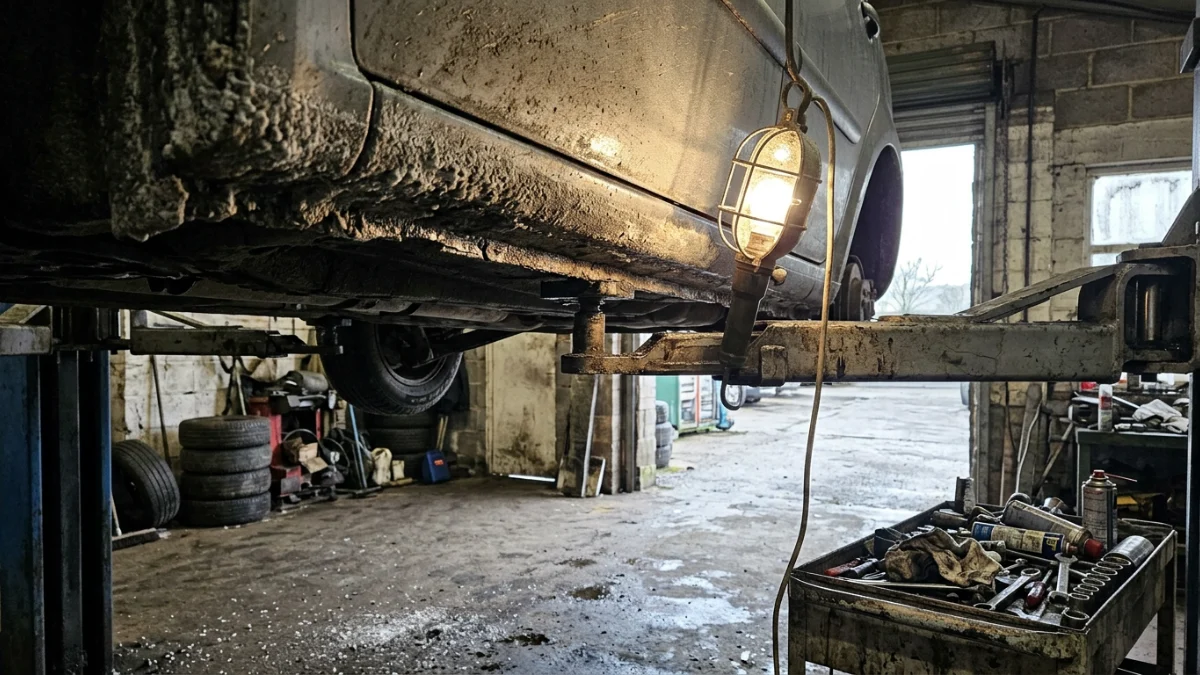
Road salt keeps working long after the road has dried. It sits on the sills, in the arches and across the subframe as a damp film, and steel corrodes for as long as it is there. Cars that live outside in CF3 and drive the gritted stretches of Wentloog Road, Newport Road and the A48 collect it every week of the salting season.
Crouch at each sill and look along it at a low angle. Corrosion starts inside a seam and reaches the paint last, so bubbling and staining from an arch lip are late stages rather than early warnings.
- Look for bubbling along the sills, flaking at jacking points, staining from the arch lips, underseal you can lift with a fingernail.
- Good looks like paint tight along the whole sill, firm metal under thumb pressure, no staining from a seam.
- Not good is metal that gives under a thumb, a hole, or corrosion near a suspension mounting or a brake pipe. The DVSA MOT inspection manual treats corrosion that has weakened metal within a prescribed area as a failure rather than an advisory.
Caught at the bubbling stage a sill is a cut and a weld. Left two more winters it becomes a structural section, which is why MOT welding and corrosion repair fills the workshop from January. Rinsing the underside and arches after a gritted week removes the film driving it.
Check ten: what to keep in the car this winter
Rinsing is one winter habit, and the boot is the other. None of this kit fixes a car, and it keeps a dark wet morning on the Wentloog levels from becoming a recovery call.
- An ice scraper and de-icer, kept in the car rather than in the house.
- A torch, because every check here is harder in the dark.
- Screenwash concentrate, mixed strong enough for a frost.
- A tyre inflator or the sealant kit the car came with.
- Jump leads or a jump pack, with the handbook page showing where to connect them.
- Gloves, a high visibility vest and a charging lead that works.
Kit covers the roadside. It cannot tell you what the car needs, which brings the check to its limits.
Which checks you can finish on your drive, and which need a ramp
Six of the ten finish on your own drive with daylight, a tread gauge and a pressure gauge. Four stop where a measurement is needed, because a drive cannot lift the car and eyes cannot read a number.
| Check | Settled on the drive | Measured at the workshop | What that tells you |
|---|---|---|---|
| Battery | Crank speed, dimming lights | Resting voltage, drop test, charging | Battery, alternator or drain |
| Tyres | Tread at three points, sidewalls | Depth at the worst point, alignment angles | Tyre, pressure habit or geometry |
| Brakes | Whether a noise clears, pull, handbrake | Pad and disc thickness, binding, efficiency | Rust, wear or a seized caliper |
| Lights and glass | Dead lamps, misted lenses, blades | Beam alignment, damage to the standard | A bulb and a blade, or a screen job |
| Coolant and oil | Levels cold, colour, leaks on the drive | Coolant strength, where a loss goes | A top up, or a drain and refill |
| Underside | Bubbling at sills, staining at arches | Inner sills, arch tops, pipes, mountings | A weld now, or a section later |
The honest limit of a driveway check is that it finds and does not measure. Braking efficiency, the inboard face of a disc, coolant strength and the top of a sill are out of reach. It is a sorting exercise, and a good one, because it turns a worry into a named item.
A named item is what a workshop can price. The position CF3 defends is that the car gets tested before it gets quoted, and the reading goes on the job sheet next to the price. A full car service covers most of this list with the car in the air, pre-MOT checks cover the lighting, tyre, wiper and corrosion items against the test standard, and evening and weekend appointments keep it out of your working day.
CF3 is a DVSA approved test station and an all makes garage at Unit 4C Wentloog Buildings, Wentloog Road, Rumney, Cardiff CF3 1TH, minutes from St Mellons, Llanrumney and the A48. Cars, vans, fleet vehicles and motorhomes go through the same workshop. Ring 07400 454839 with what you found.
Winter car check questions
How often should a winter car check be done?
The walk round is worth doing monthly through the winter, and again after a cold snap or a week of gritted roads. Pressures and fluid levels move with temperature, and salt exposure builds up. One look in November, repeated to the spring, catches most of what a drive can find.
What tread depth is safe for winter driving?
The legal minimum is 1.6mm across the central three quarters of the tread and around the whole circumference, which is a DVSA requirement. Standing water is cleared by the volume of the grooves, so depth above that minimum clears more water per second. Tyres close to the limit in November face the worst weather of the year.
Why does my car grind on the first stop of the morning?
A light grinding on the first stop is usually surface rust being wiped off the disc faces by the pads, after the car has stood overnight in damp, salted air. It disappears within a few stops. A noise that returns at every stop once the car is warm is pad or disc wear, and that needs measuring on a ramp.
Can I top up the coolant with water in winter?
Water brings the level back and weakens the mix, which lowers the freeze protection and dilutes the corrosion inhibitors. A system topped up through the year can sit at the correct level and still freeze in a hard frost. Use the correct coolant at the right concentration and have the strength tested rather than estimated.
Why does the inside of my windscreen mist up so fast?
Misting comes from water already in the car meeting cold glass, so the usual causes are wet mats and coats, a blocked cabin filter choking the airflow at the screen, recirculation keeping damp air inside, or a footwell wet from a blocked scuttle drain. Fresh air with the air conditioning on clears the glass fastest.
Does a winter check replace a service or an MOT?
A winter check replaces neither. It finds items and names them, a service corrects what has worn, and an MOT records the car against the DVSA test standard on the day. The value of the walk round is timing, because an item found in November gets booked before the test date or the first hard frost.
A list of named items is the point of the ten minutes. Work round the car cold and in daylight, write down what did not look right, and get anything touching grip, stopping or visibility booked in this week.
CF3 MOT and Service Centre is at Unit 4C Wentloog Buildings, Wentloog Road, Rumney, Cardiff CF3 1TH, minutes from St Mellons, Llanrumney and the A48 and handy for east Cardiff and the M4. Ring 07400 454839 with your registration and the list from your drive, and the car gets checked, measured and priced in that order.
Bring the winter list to the Rumney workshop
Ring CF3 MOT and Service Centre on 07400 454839 with your registration, or book through the widget above. The battery, brakes, tyres, coolant and underside are measured with the car in the air, and you get the readings before anything is agreed.

