Book Online
07400454839
-
By: Ali Hindal
- 0 Comments
An MOT checks the parts of your car that keep it safe and legal: lights and signalling, steering and suspension, brakes, tyres and road wheels, seat belts, the body structure, the exhaust and emissions, the driver’s view of the road, and the vehicle identification.
You hand the keys over, you wait, and a printout comes back covered in words you did not choose. Dangerous. Major. Minor. Advisory. Nobody at the counter explains which of those stops you driving the car home.
This page walks the inspection in the order a tester works it, says what is being looked at in each section and what turns a note into a failure, and sets out what the test never looks at. The first five sections are where a wet Cardiff winter does its damage.
What an MOT checks, at a glance
- The inspection runs to a DVSA standard and records your car as it arrived. Nothing is adjusted, cleaned or repaired during the test.
- Defects are graded dangerous, major or minor. Dangerous and major are failures. Minor is a pass with the fault written down.
- A dangerous defect means the car must not be driven until it is repaired, whatever the old certificate says.
- An advisory is a dated note on a part heading for the limit, not a complaint about the car.
- Tread must be at least 1.6mm across the central three quarters of the breadth and round the entire circumference, which is the DVSA figure.
- Engine condition, the clutch, the gearbox and the state of the engine oil are not inspected at all.
- A test taken up to one month minus a day before expiry keeps the original expiry date, under DVSA rules.
- Lights, wipers, washers, tyres and brakes are where a wet Cardiff winter turns last year’s advisories into this year’s failures.

What an MOT checks, and the order the tester works in
An MOT works through a fixed set of sections in a fixed order, and the tester records a result against each one rather than forming a general opinion of your car. Outside first, then inside, then in the air and on the rollers.
The walk round covers lights, plates, the windscreen, wipers, washers, tyres, wheels and visible body damage. The driver’s seat follows: belts pulled and locked, the wheel checked for play, the horn sounded and the dashboard warning lamps read.
The car then goes up. Steering joints, suspension, the body structure, the fuel system, the exhaust and the underside are inspected from below, and the roller brake test and the emissions probe close the job. MOT testing at a DVSA approved test station follows that sequence on every car.
Most of the first section can be checked on your own driveway, with a wall and somebody to press the pedal. Where something is already wrong, the fix costs less before the test than after it. Ring CF3 MOT and Service Centre in Rumney with your registration.
Lights and signalling
The tester checks that every lamp works, shows the correct colour, sits at the correct aim and is not damaged. Headlamps on both beams, sidelights, rear lamps, brake lamps, indicators, hazards, the rear fog lamp and the plate lamps are all included.
Aim is the part drivers forget. A beam pointing too high dazzles oncoming traffic and fails on aim alone with a new bulb fitted. A cracked lens fails where it lets water in, and heavy condensation is recorded.
A lamp that does not work, shows the wrong colour, aims wrongly or is insecure is a major defect. A small chip in a lens that still seals is an advisory. The next section needs the car in the air.
Steering and suspension
The tester checks for play, wear, damage and corrosion across the steering and suspension, with the car raised and the front wheels off the ground. The wheel is turned lock to lock while a second person watches each joint for movement it should not have.
Track rod ends, ball joints, bushes, anti roll bar links, springs, dampers, bearings and the rack with its gaiters are inspected in turn. A drop test, loading and releasing the suspension, shows up a damper that no longer controls the spring.
Failure comes from excessive play at a joint, a split gaiter, a broken or badly corroded spring, a damper leaking fluid, or a mounting rusted through. Play inside the limit is an advisory. A Renault Twingo failed its test on a lower arm and needed a starter motor as well, and the record of that job separates the two findings. Suspension repairs are quoted on the measurement, because test before you quote is the only way the number means anything.
Brakes, including the roller brake test
Brakes are inspected by eye and then measured on a roller brake tester, which records the braking force at each wheel and compares the two sides of an axle. Discs, pads, drums, shoes, pipes, hoses and the parking brake are checked before any reading is taken.
Each wheel sits on a driven roller, so a binding caliper, a glazed pad or a contaminated disc shows as an imbalance across the axle. Corroded brake pipes are the most common structural fault here, and a leaking pipe is dangerous.
Failure comes from a brake below the required efficiency, an imbalance beyond the limit, a pad or disc below its wear limit, a badly corroded pipe, or a parking brake that will not hold. A light wear lip is an advisory.
Noise arrives before the reading does. What a squeal, a grind or a spongy pedal is telling you is worth knowing in the month before the test, and brake repairs are then one booking instead of a failure and a retest.
Tyres and road wheels
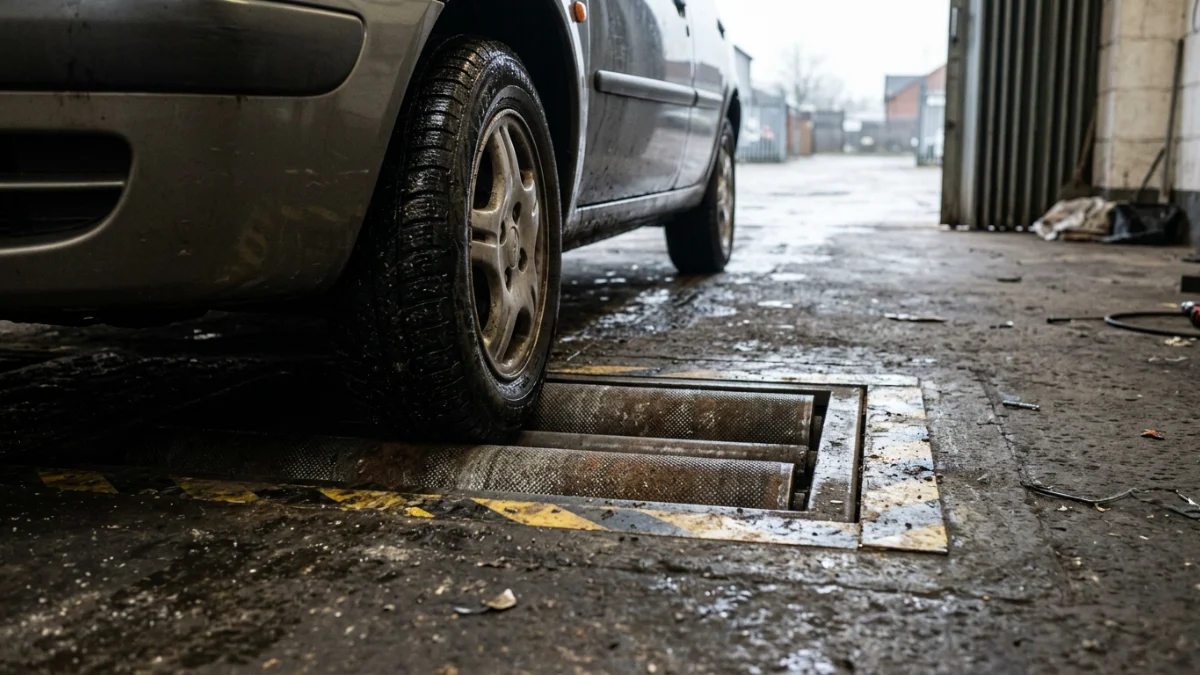
The tester checks tread depth, tyre condition, size, speed rating, matching across an axle and the wheel itself. Tread must be at least 1.6mm across the central three quarters of the breadth and round the entire circumference, which is the DVSA figure.
That wording matters more than the number. A tyre can hold legal tread through the middle and be down to the carcass on one shoulder, and it fails. Shoulder wear points at alignment or a worn joint. Cuts, bulges, exposed cords and a cracked wheel are recorded.
Tread that is low but still legal is the classic advisory, and it costs grip in standing water on the A48 long before it costs a certificate. Tyre fitting is quoted on the gauge reading, and the reading goes on the job sheet next to the price.

Seat belts, restraints and the driver’s view of the road
The tester checks every seat belt fitted to the car, the seats, the restraint warning system, and everything affecting what the driver can see through the windscreen.
Seat belts and restraints
Each belt is pulled sharply to confirm that it locks, then inspected along its length for cuts and fraying. Buckles, stalks, mountings and retractors are checked, and a belt that will not retract is recorded.
Failure comes from a belt that will not lock, webbing cut or frayed, a corroded mounting, a loose seat, or a restraint warning lamp showing a stored fault. Light fuzzing on webbing is an advisory.
Wipers, washers and screen damage in the swept area
Wipers must clear the screen effectively and the washers must deliver enough fluid to let them do it. A torn blade that smears, an arm that no longer sweeps its full arc, and an empty, frozen or blocked washer system all fail.
Screen damage is judged by where it sits. A chip or crack inside the area swept by the wipers in front of the driver fails at a smaller size than the same damage further across the glass.
This is the section a Cardiff winter attacks first. Salt spray off Newport Road, grit from the M4 slip roads and screenwash mixed too weak turn a serviceable blade into a failure fast. A set of pre-MOT checks catches all of it before a tester does. The structure under the car is next.
Body structure, corrosion and general items
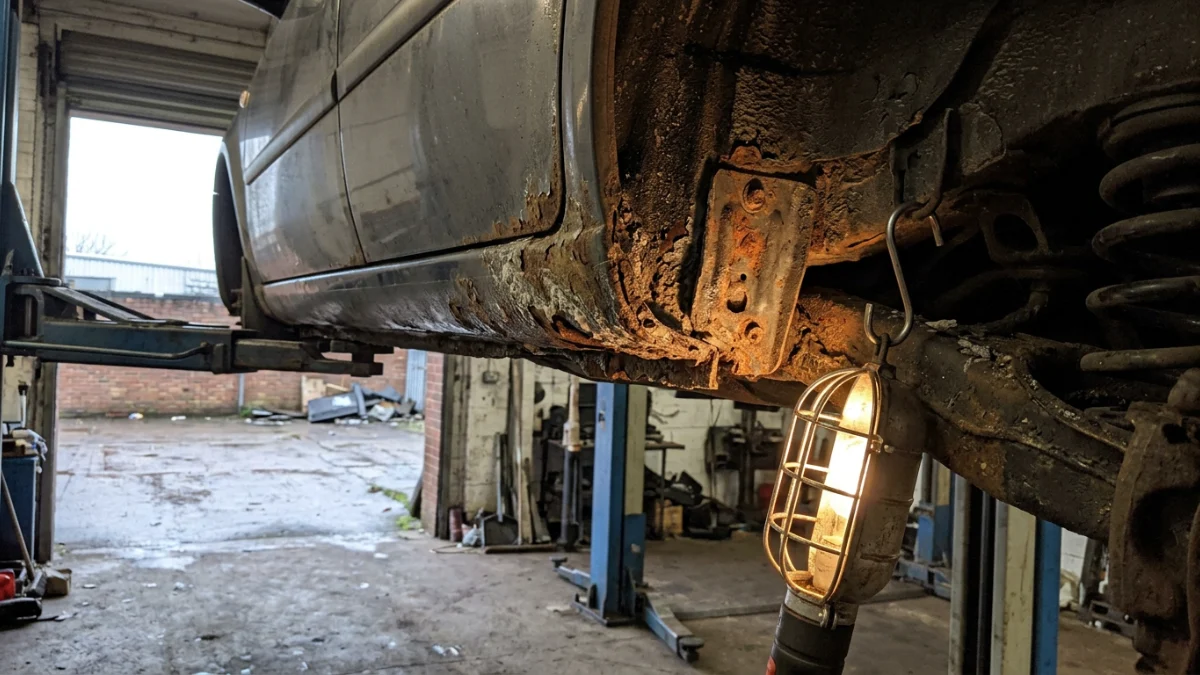
The tester inspects the body, the chassis, the subframe and the floor for corrosion, damage and insecurity, with particular attention to the prescribed areas. A prescribed area is the zone within a set distance of a load bearing or safety related mounting point.
Corrosion inside a prescribed area is treated differently from surface rust elsewhere, because the fixing it carries has to hold under load. Rust that has weakened metal around a seat belt, suspension, steering or brake mounting fails. Catches, doors that latch, mirrors, the horn, a towbar, sharp edges and battery security are the general items alongside it. Surface rust on a sill with sound metal underneath is an advisory, and it is the advisory that MOT corrosion failures grow out of.
Registration plates and the vehicle identification number
Both plates must be present, secure, correctly spaced, correctly coloured and readable, and the vehicle identification number must be legible and match the registration document. A non standard font fails, and so does a plate obscured by a towball. A VIN painted over or corroded away stops the test.
Exhaust, fuel, emissions and the extra items on newer cars
The exhaust is checked for leaks, security and noise, the fuel system for leaks and a sealing filler cap, and the emissions measured at the tailpipe against the standard for your engine and its date of first use. A blowing joint fails, a missing catalytic converter fails, visible smoke from a diesel fails, and a particulate filter cut open fails on inspection.
Newer cars bring more items in. Tyre pressure monitoring fitted from new, the stability control warning, electronic parking brake operation, daytime running lamps and headlamp levelling are all assessed, and on an electric or hybrid car the high voltage cabling and its orange insulation are inspected. A lamp lit for one of those systems is a failure. The next question is what the words on the printout mean.
| Section | What is assessed | Most common failure |
|---|---|---|
| Lights and signalling | Function, colour, aim, security | Blown bulb or a lamp aimed high |
| Steering and suspension | Play, gaiters, springs, dampers | Split gaiter or play at a joint |
| Brakes | Pads, discs, pipes, roller readings | Imbalance from a binding caliper |
| Tyres and road wheels | Tread, sidewalls, size matching | Tread under the limit on a shoulder |
| Seat belts and restraints | Locking, webbing, mountings | A belt that will not lock |
| Body and general items | Corrosion, structure, latches, horn | Corrosion in a prescribed area |
| Driver’s view of the road | Wipers, washers, screen damage | Damage inside the swept area |
| Exhaust, fuel and emissions | Leaks, noise, tailpipe readings | A blowing joint in the exhaust |
| Plates and identification | Plate format, legibility, VIN | A plate obscured by a towball |
| Electrical and safety items | Warning lamps, parking brake | A stability control lamp lit |
Dangerous, major and minor: what each one means for driving away
A dangerous defect is a failure and means the car must not be driven until it is repaired. A major defect is a failure without that immediate prohibition. A minor defect is a pass with the fault recorded.
Dangerous is the grade that changes your day. The defect presents an immediate risk to road safety or serious harm to the environment, and driving the car in that condition is an offence whatever the old certificate says. A leaking brake pipe and a tyre with exposed cords sit here.
Major means the car has failed but is not prohibited on the spot. Where the existing certificate has not expired and the car is otherwise roadworthy, it can be driven to a garage for the repair. Once the certificate has expired, the only legal journeys are to a pre arranged test or repair.
Minor sits on a pass. The tester has recorded something that needs attention but does not affect safety or the environment on the day, and neither a minor defect nor an advisory stops you driving. The pattern behind the grades is set out in why cars fail the MOT in Cardiff.
Deal with the advisory while it is still an advisory
Read last year’s certificate before you book this year’s test, then bring the car in for the items the tester flagged. One part on a planned booking beats the same part on a failure, a retest and a car off the road. Ring 07400 454839 with the advisory wording.
Advisories, and what the MOT does not check
An advisory records a part that is wearing but still meets the standard. The list of components the test never assesses is longer than most drivers expect.
Why an advisory is next year’s failure list
An advisory is a dated note from a tester who has had your car on a ramp, measured it and found a part heading for the limit. It is not a complaint and not a sales tactic. Tread at the margin, a worn pad and surface corrosion on a sill are the usual entries.
The month before the test is when an advisory is cheap: one part, one booking, and the car stays on the road throughout. The week of the test is when the same advisory is expensive, because it has become a failure and the part has to be in the building that day. MOT repairs are quoted from the reading, not from the phone call.
The parts of your car the tester never assesses
Engine condition is not inspected. Compression, cylinder wear, cambelt condition, turbo health and oil pressure all sit outside the test. The clutch and the gearbox are not inspected either, and neither is the state of the engine oil, the coolant strength or the auxiliary belt.
A car can therefore pass with oil long overdue and a cambelt years past its interval. The tester may not adjust, clean or repair anything, because the result has to record the car as it arrived. A pass says the car met the standard on the day, and nothing about March.
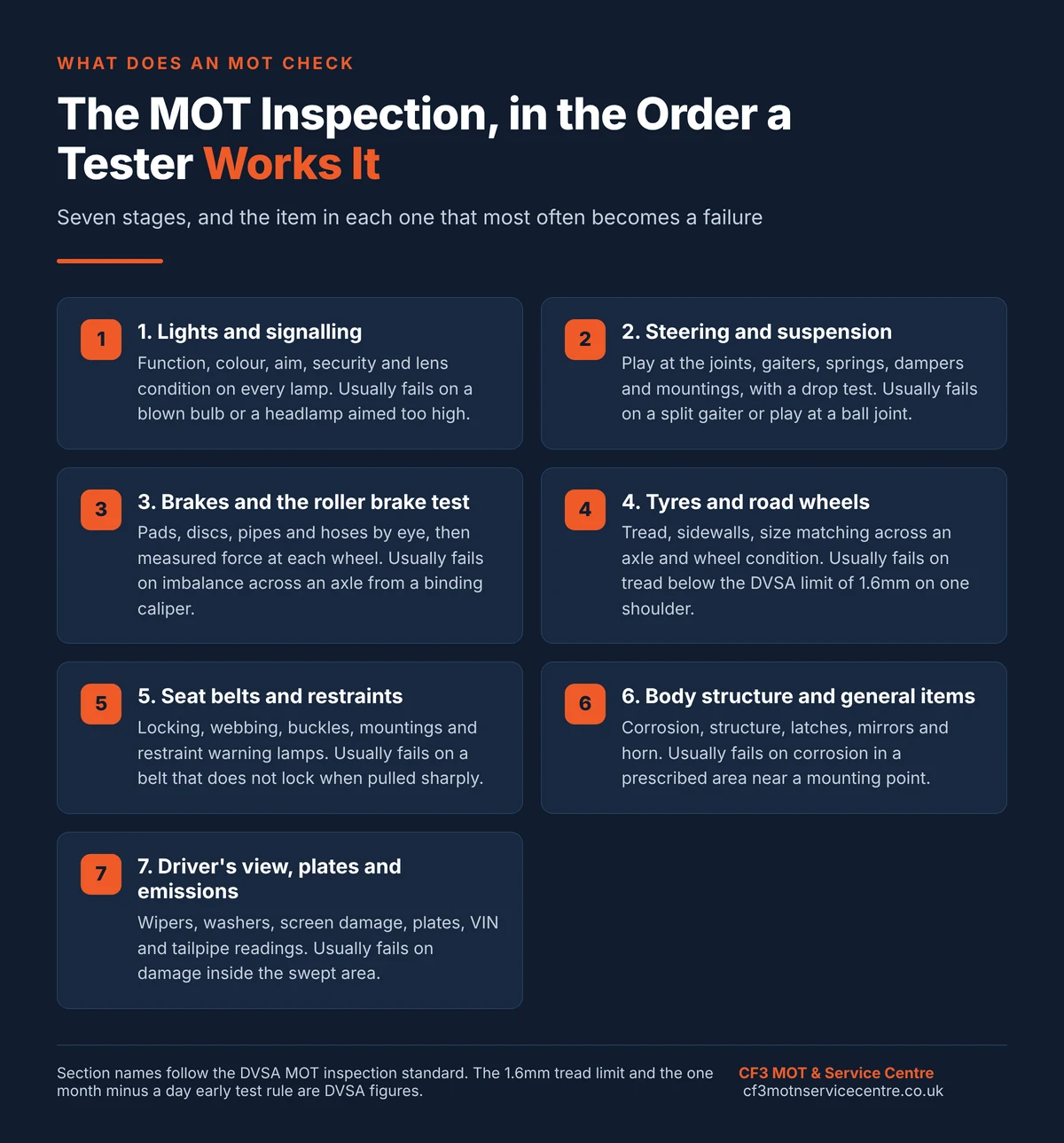
The same sequence in plain text:
- Lights and signalling. Usually a blown bulb or a headlamp aimed too high.
- Steering and suspension. Usually a split gaiter or play at a ball joint.
- Brakes and the roller brake test. Usually imbalance from a binding caliper.
- Tyres and road wheels. Usually tread below the DVSA limit of 1.6mm on one shoulder.
- Seat belts and restraints. Usually a belt that does not lock when pulled sharply.
- Body structure and general items. Usually corrosion in a prescribed area.
- Driver’s view, plates and emissions. Usually damage in the swept area or an empty washer bottle.
Testing early, the retest, and the winter that decides your result
A test taken up to one month minus a day before the expiry date keeps the original expiry date, which is the DVSA rule, so an early test costs nothing in certificate life and buys weeks to fix a failure.
That is the most useful piece of timing in the process. Present the car a few weeks early and a major defect leaves you holding a valid certificate while the repair is booked.
A retest covers the items that failed. Where the vehicle is left at the test station for repair and retested within ten working days, DVSA rules allow a partial retest at no charge, which is the reason to keep test, repair and retest on one site.
Winter decides more results in east Cardiff than any other factor. Dark afternoons put every lamp to work, standing water on the A48 finds tread that was legal in August, salt sits on sills and brake pipes overnight, and a brake stood wet and salty binds on the rollers. The winter car checks deal with most of that in one visit.
CF3 MOT and Service Centre is a DVSA approved test station and an independent all makes garage at Unit 4C Wentloog Buildings, Wentloog Road, Rumney, Cardiff CF3 1TH, minutes from St Mellons and Llanrumney. Test, repair and retest are handled on one site.
MOT inspection questions
Can I drive my car away if it fails the MOT?
A car with a dangerous defect must not be driven away until that defect is repaired. A car with only major defects can be driven away where the previous certificate is still valid and the vehicle is otherwise roadworthy. Once it has expired, the only legal journeys are to a pre arranged test or repair.
What is the difference between an advisory and a minor defect?
A minor defect is a recorded fault that does not affect safety or the environment on the day. An advisory is a note about a part that still meets the standard but is wearing towards the limit. Both print on a pass certificate and neither one stops you driving.
Does the MOT check the engine, the clutch or the gearbox?
The MOT checks none of those. Engine condition, compression, the clutch, the gearbox, the state of the engine oil, coolant strength and the auxiliary belt all sit outside the inspection. A pass certificate confirms the car met the roadworthiness standard on the day and says nothing about mechanical condition.
How early can I put the car in for its MOT?
A test can be taken up to one month minus a day before the current certificate expires and still keep the original expiry date, under DVSA rules. Testing at that point is the sensible habit, because a failure then leaves you with a valid certificate and weeks to arrange the repair.
What happens at an MOT retest?
A retest re-examines the items that failed rather than repeating the whole inspection. Where the vehicle stays at the test station for the repair and is retested within ten working days, DVSA rules allow a partial retest at no charge. Removing the car and returning it later can bring a fee into play.
Does a cracked windscreen fail the MOT?
A cracked windscreen fails where the damage sits inside the area swept by the wipers, and the allowance is smaller directly in front of the driver than further across the screen. Damage outside the swept area is usually recorded rather than failed. A hot blower spreads a chip quickly.
The inspection is a fixed list worked in a fixed order against a DVSA standard, on one day, with nothing adjusted along the way. Two things are worth taking from it: dangerous means the car stays put, and an advisory is the cheapest warning you will get.
Book your test at the Rumney workshop by ringing 07400 454839 with your registration. CF3 MOT and Service Centre is a DVSA approved test station at Unit 4C Wentloog Buildings, Wentloog Road, Rumney, Cardiff CF3 1TH, minutes off the A48 and close to St Mellons and Llanrumney.
Put your MOT in the diary before the dark months close in
Ring CF3 MOT and Service Centre in Rumney on 07400 454839, or book through the widget above. Test, repair and retest are handled at the same workshop on Wentloog Road, and every price follows a measurement.

